
A Central Florida garage is not a mild place to work. Attic heat pushes it past 100 degrees in July, and the humidity never really leaves. The workshop outlets Orlando homeowners install have to take that, plus the load of real tools. Plan the circuits first and you skip a lot of tripped breakers.
Most garages here were wired for a door opener and one light. A miter saw, a dust collector, and a mini-split were never part of that plan.
Start With an Honest Load List
Write down every tool you plan to run, then note the amps on the nameplate. Watch anything that runs for hours at a time.
- A table saw, planer, or bandsaw pulling 12 to 15 amps
- A dust collector or shop vacuum running at the same time
- An air compressor with a hard startup surge
- A mini-split or portable air conditioner for summer comfort
- A dehumidifier, which may run every day here
- Battery chargers, work lights, and the second fridge nobody mentions
Two general circuits will not carry that list. Split the loads across dedicated circuits instead. Then the saw and the dust collector can run together without a trip.
Humidity Is the Quiet Killer
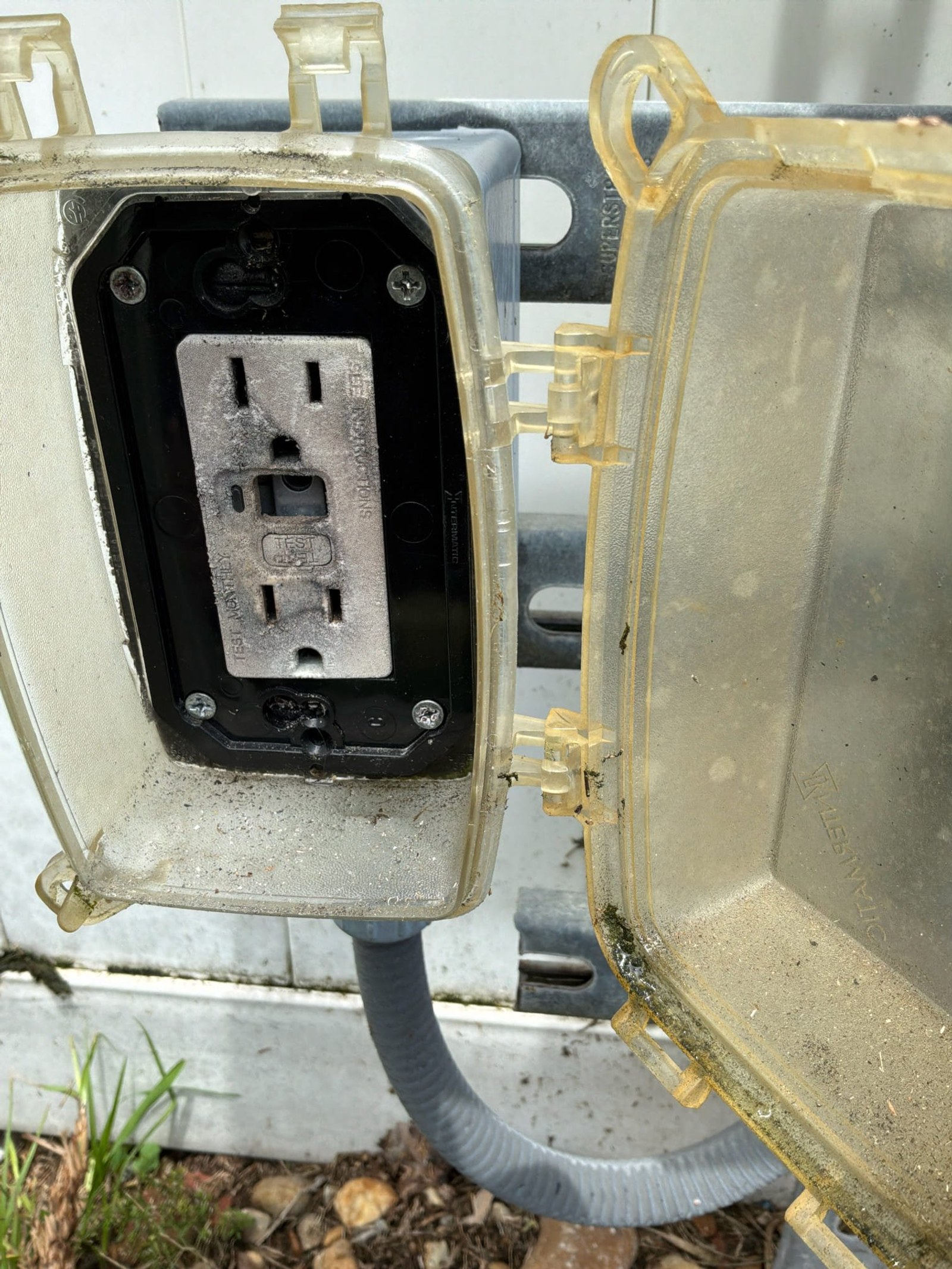
Warm, wet air turns to water on cool metal. Open the garage door on a July morning and damp settles on everything inside. Boxes rust, screws seize, and outlet contacts corrode.
Corrosion adds resistance at the connection. Resistance makes heat, and heat is how a loose wire ends up as a burned outlet. We found exactly that on a rust-stained box in Maitland.
- Use weather-resistant devices and in-use covers on carport and lanai walls
- Pick corrosion-resistant hardware anywhere outside air can reach
- Keep boxes sealed and cover plates tight against the wall
- Replace any receptacle that grips a plug loosely
- Treat rust stains as proof that water is finding a way in
Ground-Fault Protection Is Not Optional
The National Electrical Code calls for ground-fault protection in garages, sheds, and outdoor areas. Newer code cycles widened that list. Inspectors here check for it.
A GFCI breaker at the panel protects the whole circuit. That often beats reaching a device wedged behind a workbench.
Older motors sometimes trip these breakers for no clear reason. Good breakers and clean wire terminations usually fix it. The Electrical Safety Foundation International publishes plain guides on shock protection.
Test each device with its own buttons a few times a year. One that will not trip on the test button is finished, and it needs to be replaced.
Workshop Outlets Orlando Garages Actually Need
Once the load list is done, the layout gets easy. A good bench wall usually looks like this.
- 20-amp outlets every four to six feet along the bench
- At least two circuits on that wall so one tool never starves another
- A ceiling drop for a cord reel or air hose, keeping cords off the floor
- A 240-volt outlet for a welder, big compressor, or heavy saw
- A dedicated circuit for the mini-split or dehumidifier
- Lighting on its own circuit, so a tripped tool never leaves you in the dark
Height matters too. Set outlets about 48 inches up. That puts them above the bench and away from a wet floor.
Cords Are Not a Wiring Plan
Extension cords belong with tools you carry, not with tools that live in one spot. A cord that never moves is a sign the wall is short an outlet.
- Match the cord gauge to the tool, not to the length of the run
- Never run a cord through a wall, a ceiling, or a door gap
- Retire any cord with a cracked jacket or a bent ground pin
- Give the compressor and the mini-split outlets of their own
- Keep coiled cords out of the sun on a carport wall
Dedicated Circuits and Motor Loads
Motors pull a big surge of current at startup. Share a circuit and the lights dim while the voltage sags. Low voltage is hard on motors and cuts their life short.
We see the same thing with pumps. See how a new dedicated circuit fixed an overheating well pump near Belle Isle. Our article on dedicated circuits in area homes explains how many a typical house needs.
Lighting the Space Without Cooking It
Old fluorescent shop lights struggle in a hot garage. Output drops, ballasts hum, and tubes burn out early. LED strip lights turn on at once and run much cooler.
They also draw far less current, which leaves more room for tools. A light right over the bench saves your eyes on long projects.
Air movement belongs in the same plan. An exhaust fan or a mini-split keeps you and your tools out of the worst heat. Both deserve a dedicated circuit and a switch you can reach.
Detached Shops and Sheds Need a Feeder
A detached shop needs a real feeder, not an extension cord across the yard. That means a small subpanel, a ground wire run with the feeder, and often a ground rod at the shop.
Buried cable has to sit at a set depth and stay protected where it leaves the ground. Sprinkler lines and shallow roots make trenching in Apopka or Ocoee harder than it looks.
That feeder needs a permit and an inspection. Plan on the inspector seeing the open trench before anyone fills it back in.
Panel Capacity Comes First
Many homes built here between the 1970s and 1990s still run a 100- or 150-amp service. The air handler, water heater, and dryer already use most of it.
A load calculation shows what is left. When the answer is not enough, a panel upgrade comes before any bench wiring. Spare capacity, not receptacle count, decides how many workshop outlets Orlando garages can really support.
Surge Protection for Costly Tools
Central Florida sees more lightning than any other part of the country. Battery chargers, digital controls, and variable-speed tools are all at risk. A surge device at the panel is cheap insurance for a garage full of tools.
Outdoor outlets deserve their own attention, and our guide to outdoor outlets built for local weather covers them. Surge devices are covered in the National Electrical Code from the NFPA.
Build It Once, Use It for Years
A garage shop is worth wiring right the first time. Heat, humidity, and lightning all get a vote here, so the small details matter more than they would elsewhere.
Ready to wire the shop you actually want? Call Thomas Edison Electric at (407) 490-0004 for a walkthrough in Ocoee, Apopka, or Winter Park. We are licensed in Florida under EC13015487.