
Screened lanais, pool decks and driveway workspaces all run on power. The outdoor outlets Orlando homes depend on, though, sit outside in one of the toughest climates in the country. Afternoon storms, wind-driven rain, thick humidity and hard sun all attack a receptacle that was never rated for the job. Choosing the right device is a small decision with a long payoff.
Why Central Florida Weather Wrecks Exterior Receptacles
Central Florida sits in the lightning capital of the United States. Storms roll through most summer afternoons, and they drive rain sideways into anything mounted on a wall. A cover that only stops a vertical drizzle will not stop that.
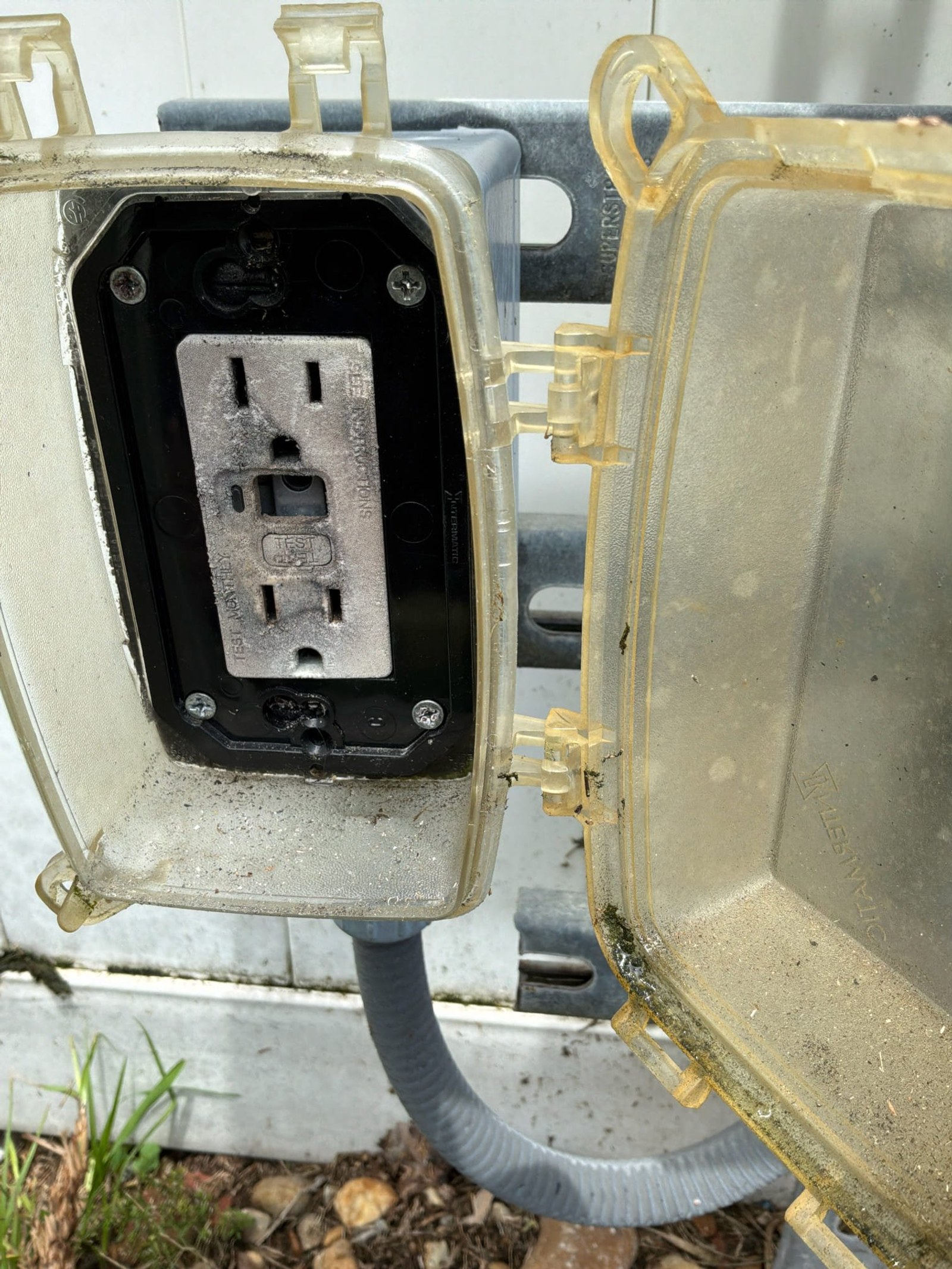
Humidity does the slower damage. Damp air turns to water inside the box at night, then the sun bakes it by noon. After a few seasons, screws rust, contacts pit, and the outlet loses its grip on a plug.
Sun matters too. Indoor-grade plastic chalks, yellows and crumbles after two Florida summers. Weather-rated parts use tougher plastic that holds its shape far longer.
What Outdoor Outlets Orlando Homes Actually Need
Today’s code says 15- and 20-amp outlets outside must be weather-resistant and tamper-resistant. Look for “WR” and “TR” stamped on the face. Those letters are not marketing. They mean the device was tested against water, rust and sun.
Ground-fault protection is the other must-have. A GFCI cuts power in a split second when current strays to ground. On a wet pool deck, that speed is the difference between a startle and an injury.
Here is a short checklist for anything you mount outside:
- A WR- and TR-rated device, not an indoor outlet hiding behind a cover
- GFCI protection, either at the receptacle or back at the breaker
- An extra-duty in-use cover listed for wet locations
- A nonmetallic or corrosion-resistant box that can drain
- A 20-amp circuit if you plan to run tools, a pump or a pressure washer
ESFI, the Electrical Safety Foundation International, publishes plain guidance on outdoor electrical safety. It is worth ten minutes before you shop.
Pools, Spas and the Rules That Follow Water
Pools and screen rooms are everywhere here, and they bring their own rules. Outlets have to sit a set distance from the water. General-use outlets near a pool need GFCI protection, and pump and heater circuits follow tighter rules still. Those clearances come from the National Electrical Code, published by the NFPA.
Bonding is the piece homeowners rarely hear about. The shell, ladders, pump and nearby metal all get tied together, so no voltage can build between them. That work is buried and out of sight, so weekend installers skip it.
We run into the results regularly. See how a new GFCI outlet protected pool equipment at an Orlando-area home that had run unprotected for years. If a spa or heater is in your plans, our guide to hot tub and pool wiring covers the circuit side of the job.
Covers, Boxes and Mounting Details Decide Lifespan
An in-use cover, sometimes called a bubble cover, seals the opening while a cord stays plugged in. Buy the extra-duty version. The thin flip-lid style cracks in Florida sun and stops closing in a year or two.
Placement matters as much as hardware. A west-facing wall takes brutal afternoon sun and blowing rain from the same direction. Under a soffit or a lanai beam, the same outlet lasts far longer.
Sealing behind the box is the last detail. Stucco and lap siding both let water track behind a poorly caulked flange. That water ends up inside the box, and corrosion starts where nobody can see it.
Smart, USB and Heavy-Duty Options Worth Considering
Landscape lighting, string lights and holiday displays all run better on a timer. Smart outlets handle that well, but read the label. Many smart plugs are rated for indoor use only, and our damp air finds them fast.
USB outlets are handy on a covered porch or in an outdoor kitchen. Keep them under cover, since the ports are the weak point. For a shed, garage or shop, step up to a dedicated 20-amp circuit instead. Our notes on outlets for home workshops explain why.
Signs an Exterior Outlet Needs Attention
Most failures announce themselves early. Twice a year, walk the perimeter and check the outdoor outlets Orlando storms hit hardest. Look for these warning signs:
- Rust streaks running down the wall from the box
- A cover that no longer latches or has gone brittle
- A plug that falls out or feels loose in the slots
- A GFCI that will not reset, or that trips with nothing plugged in
- Discoloration, buzzing or a warm faceplate
- No test button anywhere on the circuit
Any of those is a reason to stop using the outlet. A tripping GFCI is doing its job, so treat repeated trips as information rather than a nuisance.
Check the Circuit, Not Just the Device
Swapping a receptacle is the easy part. The harder question is what feeds it. Older Orlando houses often have exterior outlets spliced off a bedroom circuit, run in cable never rated for damp locations, or fed without an equipment grounding conductor.
An electrical safety inspection maps what is behind the wall. Ask about surge protection at the panel during the same visit, since lightning damage here rarely stays in one spot.
When it is time to replace or add the outdoor outlets Orlando yards and patios really need, our licensed team can handle the design, the permit and the install. Call Thomas Edison Electric at (407) 490-0004 to schedule. We hold Florida license EC13015487 and serve Orlando, Winter Park, Oviedo, Maitland, Apopka and nearby communities.