
The quietest upgrade in a Central Florida house is often a circuit nobody ever sees. A dedicated circuit feeds one appliance, with nothing else sharing the wire. That separation matters here, because the air conditioner cycles most of the year and the pool pump runs most of the day. This guide covers the dedicated circuits Orlando homes need, and how to tell when yours are stretched thin.
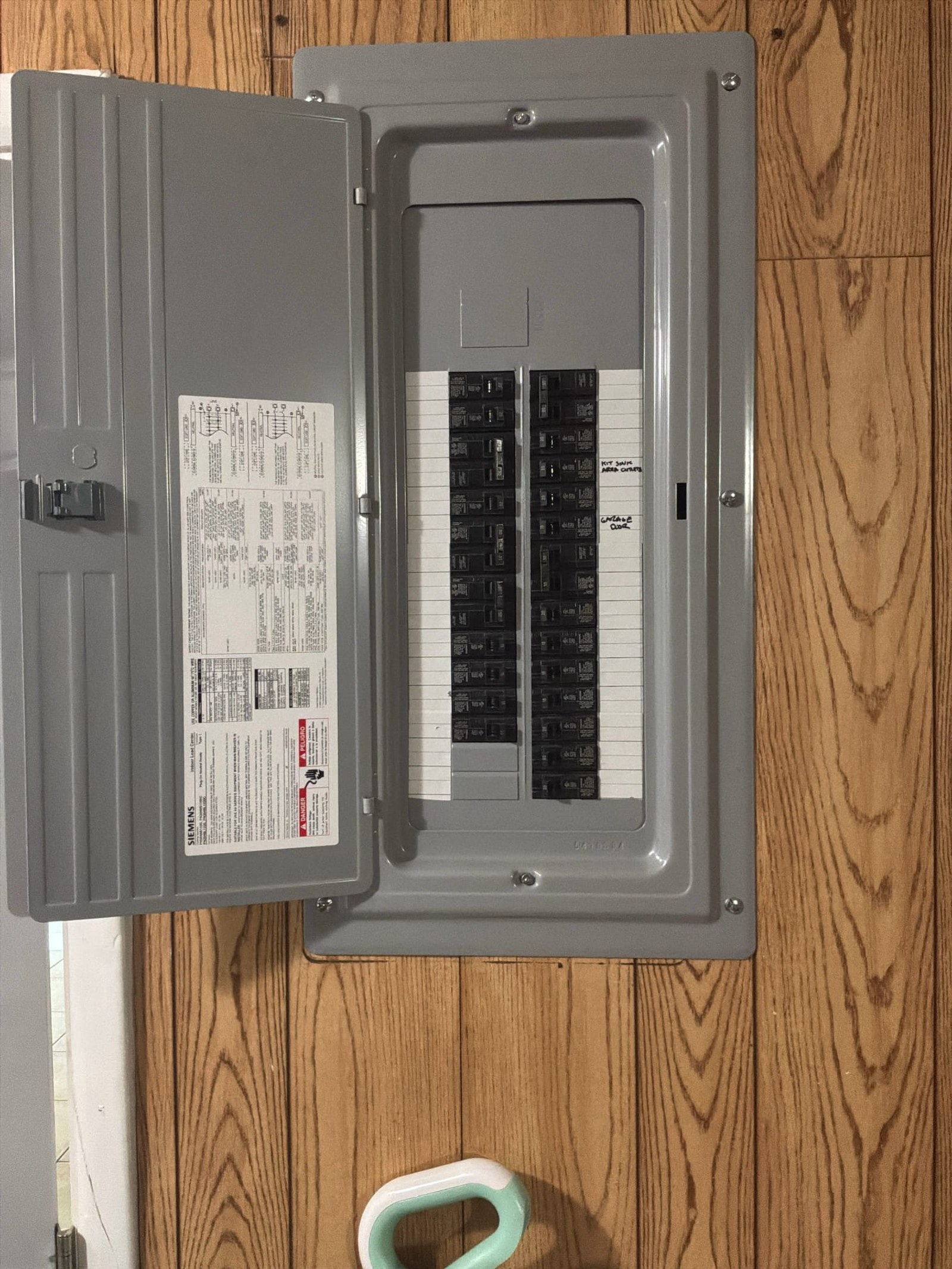
So how many of these circuits does a local house actually need? The count depends on what you already own, which makes a written list the place to start.
What a Dedicated Circuit Actually Is
One breaker, one cable, one appliance. No other outlets, no lights, nothing shared. That split stops nuisance trips, protects sensitive gear, and makes tracing a fault much faster.
It is also a code rule for many appliances, not a luxury. The National Electrical Code names the gear that must have its own circuit, and an inspector checks for it during a permit review.
How Many Dedicated Circuits Orlando Homes Need
Most new houses land between eight and sixteen. Homes built before the 1990s, however, often have far fewer. Three things drive the count:
- Square footage, and how many rooms hold heavy gear.
- The appliance mix, from a heat pump to a tankless water heater.
- Code rules, which have grown with each update cycle.
A 1960s bungalow in College Park may have three. By contrast, a new build in Lake Nona may have sixteen. Neither number is wrong on its own. That said, the older house usually needs work before you add anything to it.
Appliances That Need Their Own Circuit
The list below covers the loads that get a circuit of their own in nearly every Orlando home:
- Air conditioner or heat pump, the largest load in most local homes.
- Indoor air handler, tucked in a closet, garage, or attic.
- Electric water heater, or a much larger feed for a tankless unit.
- Range, wall oven, or cooktop, all on 240 volts.
- Refrigerator, which runs day and night without a break.
- Dishwasher and garbage disposal.
- Microwave, especially an over-the-range model.
- Clothes washer and electric dryer.
- Pool pump, hot tub, and pool heater.
- EV charger, well pump, and garage door opener.
A Dedicated Circuit for Air Conditioner Gear
A dedicated circuit for air conditioner gear is not optional here. The outdoor unit needs a breaker sized to its nameplate, plus a disconnect within sight of the equipment. The indoor air handler takes a line of its own as well.
Our cooling season stretches across most of the year, so that gear cycles constantly. A crowded circuit forces the compressor to fight voltage drop on every start. Over the years, that shortens the life of the costliest appliance in the house.
Circuits Central Florida Homes Add
Local life adds loads a generic checklist misses. Screened-lanai pools bring a pump circuit and often a heater. Garage freezers are everywhere here too, and one sharing a line with power tools can trip unnoticed. That means spoiled food you find days later, so a freezer deserves a circuit planned around it.
Two more belong on many local lists. Homes out toward Apopka and St. Cloud often run on a well, and that pump needs its own feed. Storm season then argues for a generator interlock and a backup circuit that carries the fridge, a few lights, and a window unit.
Retrofitting a Circuit in an Older Orlando Home
Running new wire here is not the same job it is in a house with a basement. Most Orlando homes sit on a slab, and the exterior walls are concrete block with shallow furring strips. There is also no floor cavity to work from underneath.
So most runs travel through the attic instead, and a Central Florida attic hits punishing temperatures by mid-morning. We plan those pulls early in the day and use interior partitions wherever the layout allows. Exposed runs get conduit, which also keeps the work inspection-ready.
Permits, Panel Space, and Labels
Adding a circuit needs a permit in Orange, Seminole, and Osceola counties. An inspector then reviews wire size, breaker type, and terminations. That step is genuinely useful, because it catches shortcuts before drywall hides them.
Panel space is the other limit. Many panels from the 1980s and 1990s are already full, and tandem breakers are not allowed in every slot. We count open spaces before we promise anything, because a full panel turns simple work into a panel upgrade.
Labeling is the cheap part of the job, yet it pays off later. A clear panel schedule saves you real time when a breaker trips during a summer storm.
How We Audit Your Circuits
We start at the panel and map what each breaker feeds. Then we test the busy circuits under load. In most homes the whole check takes about an hour.
You get a written list afterward. It shows which appliances share a line, which ones need a circuit of their own, and what a fix would take. Pair that list with our guide to how to calculate your Orlando home’s electrical load, which tells you whether the service itself still has room.
Signs Your Circuits Are Spread Too Thin
These symptoms point at circuit count rather than at panel capacity:
- An extension cord or power strip permanently feeds a fixed appliance, such as a garage freezer or a window unit.
- The refrigerator and the microwave answer to the same breaker.
- Your panel schedule shows no spare slots, so a new circuit has nowhere to land.
- Two appliances have been sharing a line temporarily since a remodel years ago.
- An appliance manual calls for a dedicated circuit that nobody ever ran.
One of these is worth a conversation. Three of them usually mean the problem has outgrown single circuits. Our guide to panel upgrades for Orlando homes covers what that larger project involves.
Why the Separation Matters
Shared, overloaded circuits remain a leading cause of home electrical trouble. Splitting the big loads apart cuts that risk, extends appliance life, and keeps one fault from taking down half the kitchen. A permit review turns up the dedicated circuits Orlando inspectors expect to see. Those requirements come from the National Electrical Code, published by the National Fire Protection Association.
Heat strengthens the case here. A pump or compressor on a crowded line runs hotter and fails sooner in Florida than in almost any other climate. For a local example, see how a panel upgrade left this Belle Isle home better protected.
Get Your Circuits Right
Whether you are building out a kitchen in Winter Garden or wiring a garage in Sanford, the wiring behind the walls has to keep up. We map the dedicated circuits Orlando homes already have, then flag the ones still missing. Thomas Edison Electric is licensed in Florida under EC13015487. Call (407) 490-0004 for a circuit and panel check.