
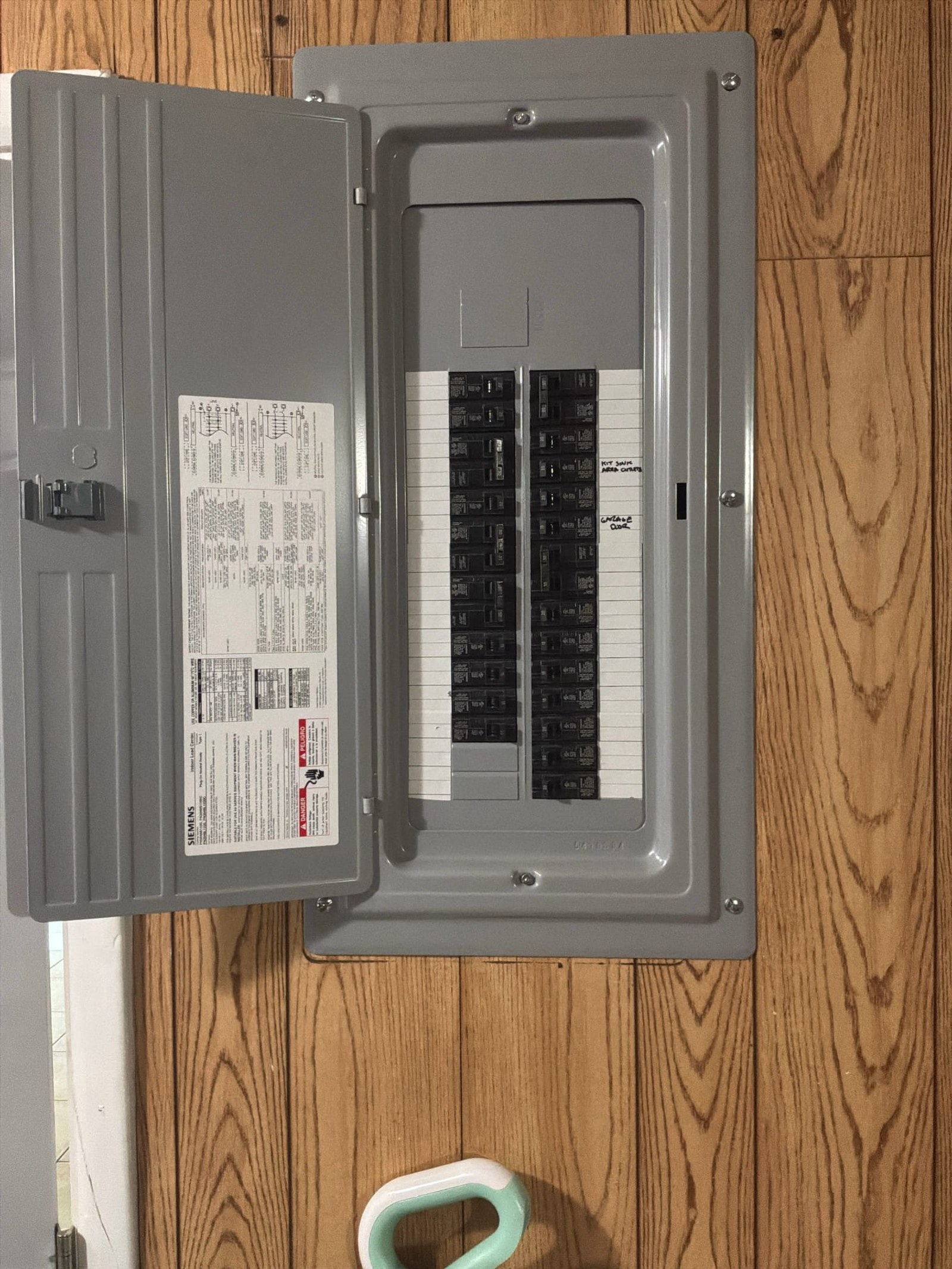
Your home’s electrical load is simply the total power everything draws at once. That number tells you whether your service can handle one more appliance. Cooling rules the calendar in Central Florida, so demand peaks with the heat rather than the cold. Here is how to add up the electrical load Orlando homes carry, and when to hand the math to a licensed electrician.
What Electrical Load Means
Load is measured in watts, or in volt-amperes on a formal worksheet. Your panel and service wires have a fixed capacity. As demand nears that ceiling, breakers trip and wires run hot.
A home electrical load calculation is how you find out where you stand. It is also required whenever you add a large appliance or change the size of the service.
Step One: Inventory What Draws Power
Start with a written list, grouped so nothing hides:
- Cooling: the heat pump or air conditioner, plus the air handler.
- Major appliances: water heater, range, dryer, dishwasher, fridge.
- Fixed extras: pool pump, hot tub, well pump, EV charger.
- Everything else: lighting, general outlets, and small devices.
Nameplates on the gear give you real numbers. Use those instead of averages when you can find them. After all, a rough guess is what wrecks the whole estimate.
The Formula, in Plain Terms
Watts equal volts times amps. If a nameplate lists amps, multiply by 120 for a standard circuit or 240 for a heavy one. So a 24-amp outdoor unit at 240 volts draws about 5,760 watts.
Steady loads get extra headroom. Anything that runs three hours or more counts at 125 percent of its rating. In Florida, that rule lands on the gear you use most.
Sizing a Service for the Electrical Load Orlando Houses Carry
The code offers a shortcut for houses, and it beats adding up every bulb. Start with three volt-amperes per square foot for general lighting and outlets. Add 1,500 for each small-appliance circuit and for the laundry circuit.
Then add the nameplate ratings of the fixed appliances. Count the first 10,000 volt-amperes at full value and the rest at 40 percent. Finally, add the larger of heating or cooling at full value.
That last step is where Florida differs. Cooling almost always wins here, so your heat pump enters the total at 100 percent.
A Worked Example for an Orlando Home
Picture a 1,900-square-foot home in Altamonte Springs with a pool:
- General lighting at three per square foot: 5,700
- Two small-appliance circuits plus laundry: 4,500
- Water heater, range, dryer, and dishwasher: 22,700
- Pool pump: 1,500
Those add to 34,400. The first 10,000 counts in full. Then the rest, 24,400, counts at 40 percent, or 9,760. Add a four-ton heat pump at roughly 5,760, and the total reaches about 25,500 volt-amperes.
Now divide by 240 volts and you land near 106 amps. A 150-amp service handles that with room to spare. A 100-amp service is already full, and that is where plenty of older Orlando homes still sit.
Where the 80 Percent Rule Fits
A service should not sit pinned at its rating. The working guide is 80 percent of capacity for steady demand. A 200-amp service, for example, stays comfortable up around 160 amps.
If your own numbers creep past that line, plan an upgrade before you add anything else. Our panel upgrade service handles the math, the permit, and the install.
Quick Signs Your Demand Is Too High
- Breakers trip when the dryer and the oven run together.
- Lights dim each time the air conditioner kicks on.
- The panel feels warm to the touch near the main breaker.
- You added a pool, a charger, or a hot tub since you moved in.
Any one of these is worth a look. Two or more usually means the service is too small for the way you live now.
Planning for EV Charging and Storm Backup
New equipment is what pushes most local homes over the line. A 48-amp charger counts as 14,400 volt-amperes once you apply the steady-load factor. That one addition can lift the electrical load Orlando homeowners live with past what a roomy 150-amp service can safely hold.
There is a middle path, though. Load-management devices let a charger back off when the house is busy, which often avoids a full service upgrade. Generator interlocks deserve the same planning before hurricane season arrives.
For the efficiency thinking behind these numbers, the U.S. Department of Energy is a solid reference.
Electrical Service Size for an Orlando Home
Service size is the practical output of all this math. Many Orlando houses built before 1980 still run 100-amp service, which suited the appliances of that era. Add central cooling, a pool pump, and a charger, and the picture changes.
Still, upsizing the service is more than a new panel. It can involve the meter can, the service entrance wires, and a call to the utility. So we scope all of it up front rather than mid-job.
When to Call a Professional
Online calculators give a ballpark. They cannot read your nameplates, check your service wires, or guess what an inspector will want. Warm breakers, scorch marks, or frequent trips mean it is time for a real look.
A new panel also exposes problems the old one hid. See how a Belle Isle panel modernization brought a home up to current code. If your gear is aging, review the signs your Orlando home needs a panel replacement.
Keep Your System Safe and Efficient
An accurate calculation lets you add what you want without guessing. Pair it with our guide to how many dedicated circuits an Orlando home needs when you plan new work.
Whether you are in Kissimmee, Oviedo, or St. Cloud, our licensed team can run the numbers on site. Thomas Edison Electric is licensed in Florida under EC13015487. Call (407) 490-0004 to schedule a load assessment.