
Central Florida builds fast. Around Horizon West, Lake Nona, Winter Garden, and Oviedo, whole streets go up in a single season. A year after closing a breaker trips, or a lanai outlet quits, and the late-night searching starts. Most of those “electrical problems construction Orlando” searches trace back to move-in day.
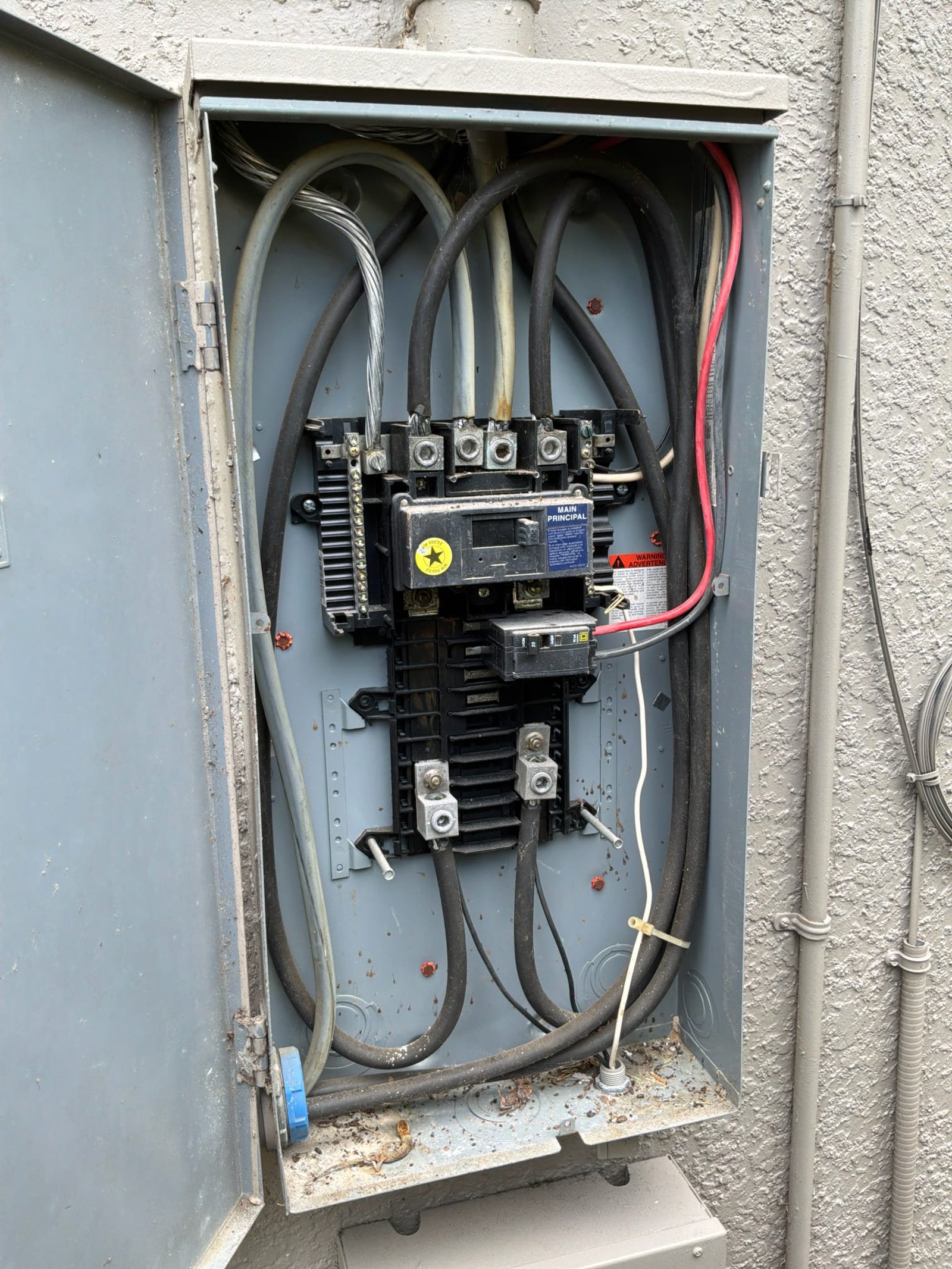
A new house is not the same thing as a finished house. Here is what tends to go wrong in our market, and how to catch it while someone else still pays to fix it.
Why New Homes Here Fail in Their Own Way
Most homes in our area sit on a slab. Outside walls are often block with a furred-out inside finish. There is no basement, so nearly every cable run lives in the attic.
That attic gets brutal. Well over 120 degrees is normal on a July day. Heat cycles work connections loose, and damp air finds any gap in an outdoor box. A sloppy splice that would sit quiet in a cool climate slowly cooks here.
Add near-daily summer lightning and the margin shrinks further. So the small details a crew skips do turn into real problems within a few years.
What “Electrical Problems Construction Orlando” Usually Means
It rarely means anything exotic. Crews on a deadline repeat the same short list of misses, and each one is easy to confirm with a meter and ten minutes.
- Wires pushed into the back of an outlet instead of landed on screws, which loosen as the house heats and settles.
- No GFCI at the lanai, the garage, or the pool pump, where code has called for it for years.
- Outdoor covers that do not close over a plugged-in cord, so rain gets in.
- Ceiling boxes that are not fan-rated, in a market where each bedroom gets a fan.
- Bonding gaps at the pool deck, the pump, and the screen room.
- A panel with no spare breaker spaces left for what you add later.
- Missing labels, so nobody can find the right breaker in a hurry.
Every item on that list is cheap to correct while the builder still owns it. The same repairs get costly once the drywall, tile, and yard are done.
Give Surge Protection a Second Look
Our part of the state leads the country for lightning. Storms build most summer afternoons. A strike does not have to hit your roof to send a spike down the service.
Recent code editions call for a surge device at the service on new homes, and Florida follows the National Electrical Code. Still, check it yourself. Make sure the device is there, wired in, and showing a green light.
Those devices also lean on solid grounding. If the ground connection is loose, the guard is mostly for show. Our guide to whole-house surge protection explains how panel and plug-in layers work together.
Plan for How Florida Homes Really Live
A new panel can look roomy and still be short. Homes here run hard all year, because the AC rarely gets a long break.
Think about what shows up after move-in. A pool pump and heater. A summer kitchen on the lanai.
A garage freezer, a well pump, or a car charger often follows. Each one wants a breaker space and real capacity.
Ask your builder for the load count in writing. Then ask for empty conduit from the panel to the garage and attic. Conduit is cheap before the stucco goes on. Fishing new wire through block walls later is not.
Think about the lanai as well. Many buyers add a summer kitchen, a spa, or a screen-room fan within two years. A rough-in now costs a fraction of that same work later.
Use Your Warranty Window
Builders back their work for a set time after closing. The smart move is to book your own check a month or two before that window shuts.
Take photos, then send every finding as one written list. A single tidy punch list gets a better answer than five phone calls. Owners in Oviedo, Ocoee, Sanford, and Apopka have used that exact play to get real defects fixed at no cost.
Buying a resale built in the last ten years? The same checks apply. Our new-construction inspection checklist is a good place to start.
What a Real Check Turns Up
A licensed pro tests instead of eyeballs. That means GFCI and AFCI trip tests, a look at every termination, and a read on the panel under load. Outdoor gear gets opened too.
The findings are often dull and important. See how a routine visit turned into a clear roadmap of code gaps for one Oviedo family. A full electrical safety inspection covers the panel, grounding, devices, and every outdoor circuit.
Want to read the rules yourself? The NFPA writes the National Electrical Code, and ESFI keeps plain-language homeowner guides online.
Questions to Ask Before You Close
You do not need trade terms to get useful answers. Ask who holds the license on the job. Ask if the surge device is included or an upgrade. Ask how many spare breaker spaces the panel has.
Then ask if the lanai and pool circuits were bonded and tested. A builder who answers these fast is usually running a tight job. Hesitation tells you where to look first.
Maybe a breaker keeps tripping in a house that is barely a year old. Maybe a late-night search for “electrical problems construction Orlando” is what brought you here. Either way, a second set of eyes is worth booking while the warranty still has teeth.
Just closed near Orlando, Winter Park, Lake Mary, or Kissimmee? Call Thomas Edison Electric at (407) 490-0004 to set up a visit. We hold Florida license EC13015487, and we are glad to walk the house with you.