
Good lighting changes how a house feels and how it works. In Central Florida it also has to stay cool. Your air conditioner runs most of the year here, so every wasted watt overhead turns into cooling load below. That one fact shapes everything below, so we wrote this home lighting guide Orlando homeowners can work through room by room.
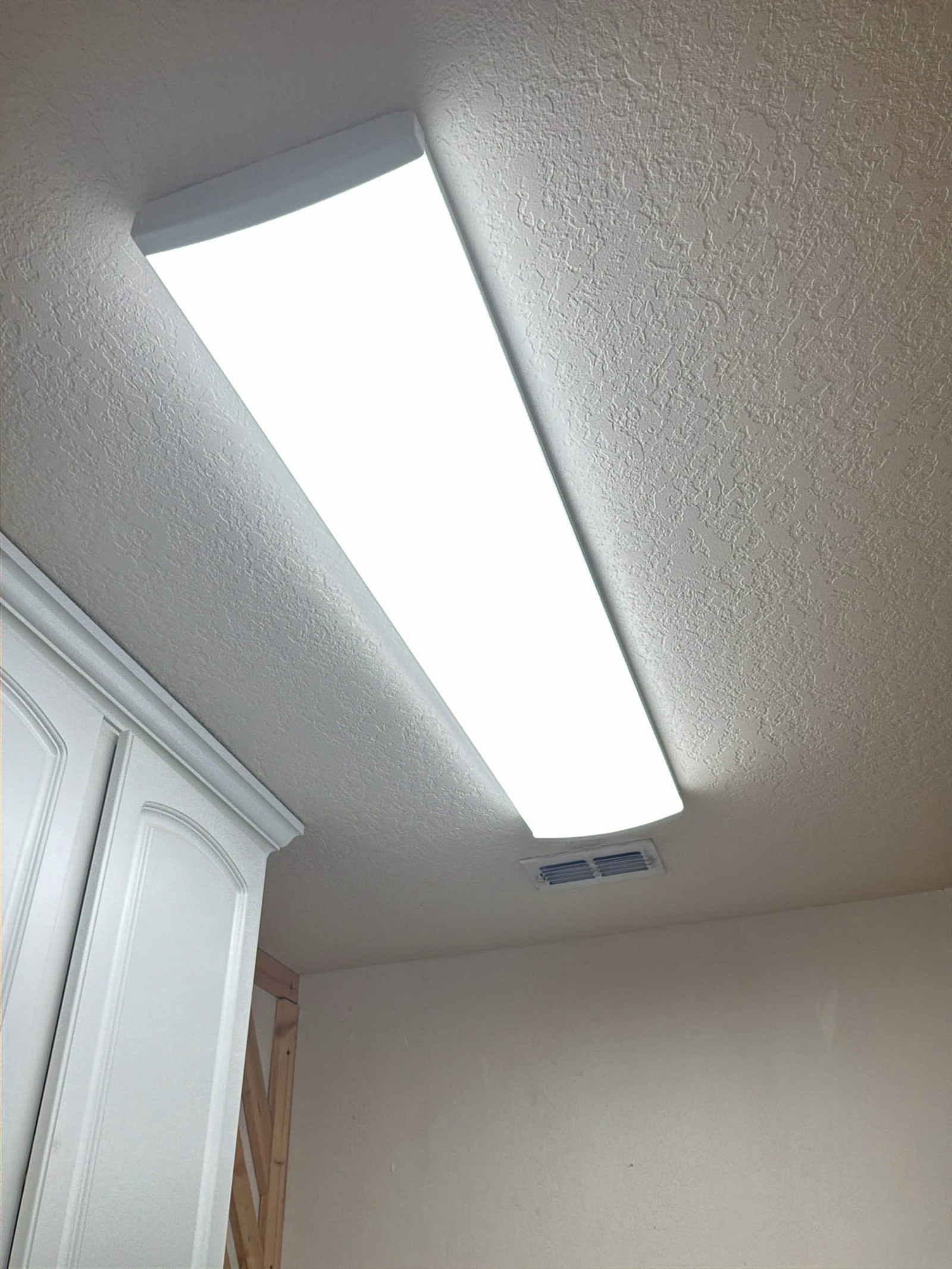
We will move from daylight and layering to LED choices, dimmers, and storm protection. You will see what to buy, what to ask, and where the local climate changes the answer.
How Florida Daylight Shapes Your Plan
Start by watching your own rooms for a full day. Our sun is strong, yet the light indoors is often uneven. A wall of sliders can flood a great room by noon while the hallway beside it stays dim.
Mature oak canopies in College Park, Winter Park, and Maitland shade entire rooms. Screened lanais and pool cages then filter daylight again before it reaches the glass. Because of that, a Central Florida house often needs more fixtures than its square footage suggests.
Home Lighting Guide Orlando: Layer Every Room
Skip the single fixture in the middle of the ceiling. Give every room three layers you can switch between:
- Ambient light fills the space, usually from recessed cans, a flush fixture, or a fan light kit.
- Task light aims at work, such as under-cabinet strips over a counter or a lamp beside the bed.
- Accent light adds depth by washing a wall, a tray ceiling, or a palm in the yard.
Open floor plans lean hard on the ambient layer. Recessed fixtures handle that job well, because they vanish into the ceiling and spread light evenly. Our team can map a balanced layout through our recessed lighting installation service, then add task and accent fixtures where they earn their keep.
Why an LED Upgrade Pays Off Here
LEDs use up to 80 percent less energy than incandescent bulbs and last far longer. They also run cool, which matters more here than in almost any other market. Halogen cans dump heat into the room, and your air conditioner then pays to remove it.
So a retrofit pays you back twice. You cut the lighting bill, and you lighten the cooling load at the same time. The Department of Energy breaks down the math in its guide to lighting choices that save money.
Shop by lumens rather than watts, since watts no longer tell you much. Check the ENERGY STAR bulb listings before you buy a case of anything. A cheap bulb that fails in a year costs more than the label suggests.
Pick Color Temperature Room by Room
Color temperature quietly decides whether a room feels warm or clinical. The number on the box makes it easy to compare. Use this as a starting point:
- Living rooms and bedrooms: 2700K to 3000K for a warm, relaxed feel.
- Kitchens and baths: 3000K to 3500K so colors read true at the counter and mirror.
- Garage, laundry, and workshop: 4000K for crisp, high-contrast task light.
- Lanai, patio, and entries: warm 2200K to 2700K, because amber tones draw fewer insects.
- Anywhere you cook or apply makeup: look for a color rendering index of 90 or better.
Keep the temperature consistent within a sight line. Mixed tones in one open room read as a mistake, even when nobody can name why.
Lighting Ideas Orlando Homeowners Ask About
A few requests come up again and again across Oviedo, Ocoee, and Lake Mary. Most are simple once the wiring is planned:
- Lanai and pool-cage lighting built from damp or wet rated fixtures and weather-resistant switches.
- Slim retrofit LED disks that replace tired cans without opening the ceiling.
- Two-story foyer fixtures on a lift so bulb changes stay safe.
- Closet lights, where code sets clearances between the fixture and stored clothing.
- Low-voltage uplighting on palms and oaks, run from a transformer and timer.
Outdoor work has its own rules. Every exterior fixture must be listed for damp or wet locations, and outdoor receptacles need GFCI protection. See our approach to outdoor lighting installation for Orlando homes for layouts that survive August, and read under-cabinet lighting for Orlando kitchens if your counters sit in shadow.
Dimmers, Fans, and Smart Switches
Dimmers stretch bulb life and trim energy at the same time. The catch is compatibility, because not every LED pairs cleanly with every dimmer. A mismatch shows up as flicker, buzz, or a very narrow dimming range.
Smart switches add another wrinkle. Most need a neutral wire in the switch box, and many older houses were wired with switch loops that have none. An electrician can confirm what sits behind your wall plate before you order a set.
Protect Fixtures From Storm-Season Surges
Central Florida is the lightning capital of the country. Storms roll across Orange and Seminole counties nearly every afternoon from June into September. Meanwhile every LED fixture holds a small driver, and drivers are electronics.
A whole-home surge device at the panel is your first line of defense. Point-of-use protection at media centers and smart hubs adds a second. Together they keep one nearby strike from wiping out every fixture in the house.
Wiring Realities in Block Homes
Concrete block walls change how fixtures get installed. Running new wire down an exterior wall often means furring, surface conduit, or a path through the attic instead. Attics here can pass 130 degrees by midafternoon, so crews plan long runs for early morning.
Insulation matters too. Recessed housings buried in blown insulation must be IC-rated, and airtight models cut the leak between attic and ceiling. New circuits generally require a permit and inspection, while a like-for-like fixture swap usually does not.
What to Ask Before You Hire
- Can my panel carry added lighting circuits, or is it already full?
- Which fixtures are rated for the damp conditions on my lanai?
- Do my switch boxes have neutrals for smart switches?
- Will this work need a permit in my city or county?
- Which dimmer model is tested with the LEDs you plan to install?
Repeat failures usually point at wiring rather than bulbs. We traced one stubborn fixture to a deeper fault and delivered a lasting repair. You can see how we handled this for a Winter Park home.
Light Your House the Right Way
Boiled down, the advice is short. Layer each room, choose efficient LEDs, match the dimmer to those LEDs, and guard the system against surges. Those four moves are the whole home lighting guide Orlando homeowners ask us for. Do that, and your house looks better, feels cooler, and costs less to run.
Ready to plan the lighting in your own house? Call Thomas Edison Electric at (407) 490-0004 to book a consultation with a licensed Orlando electrician. We work under Florida license EC13015487 and put every quote in writing first. We serve Orlando, Winter Park, Oviedo, Sanford, Ocoee, and nearby communities.