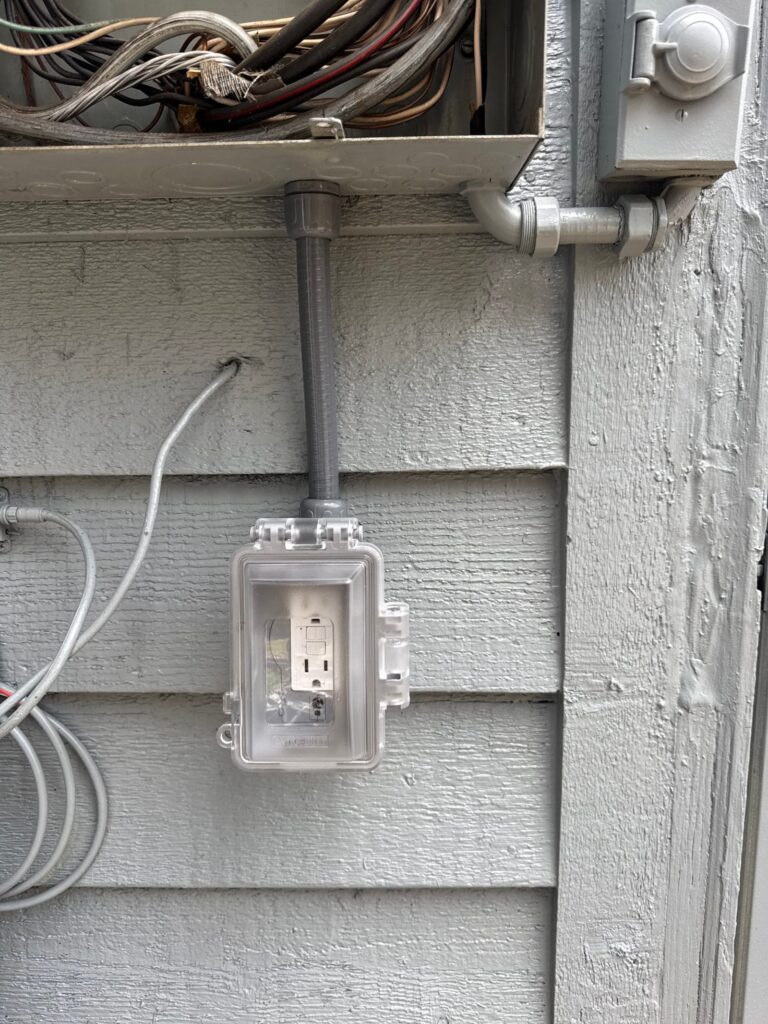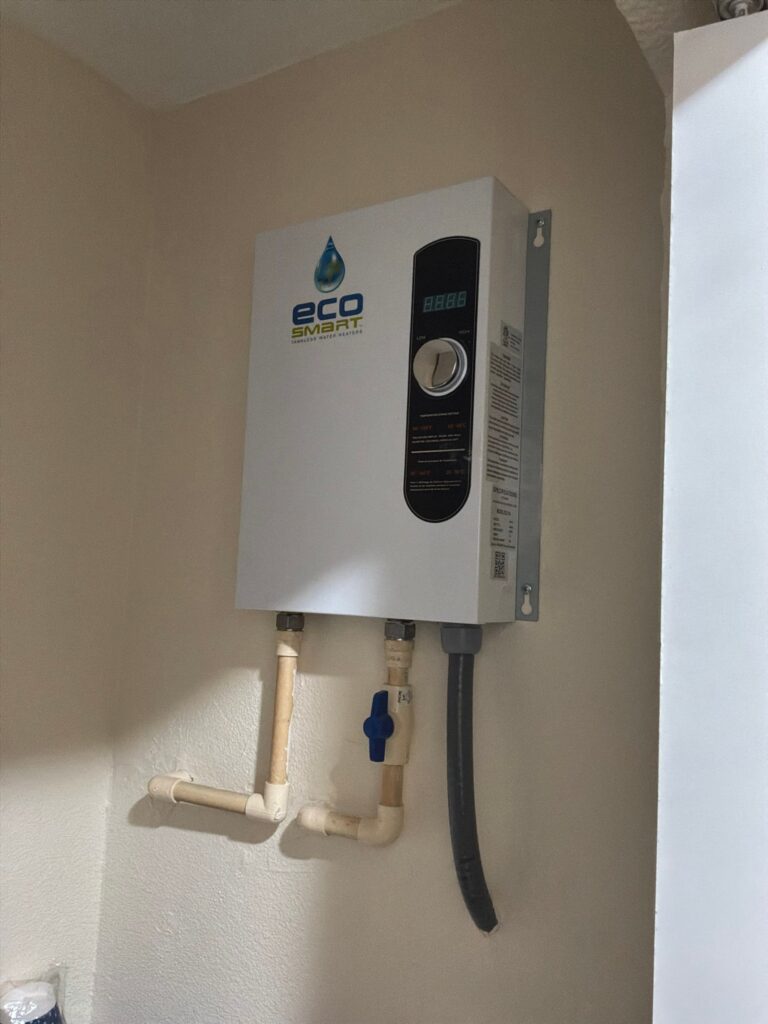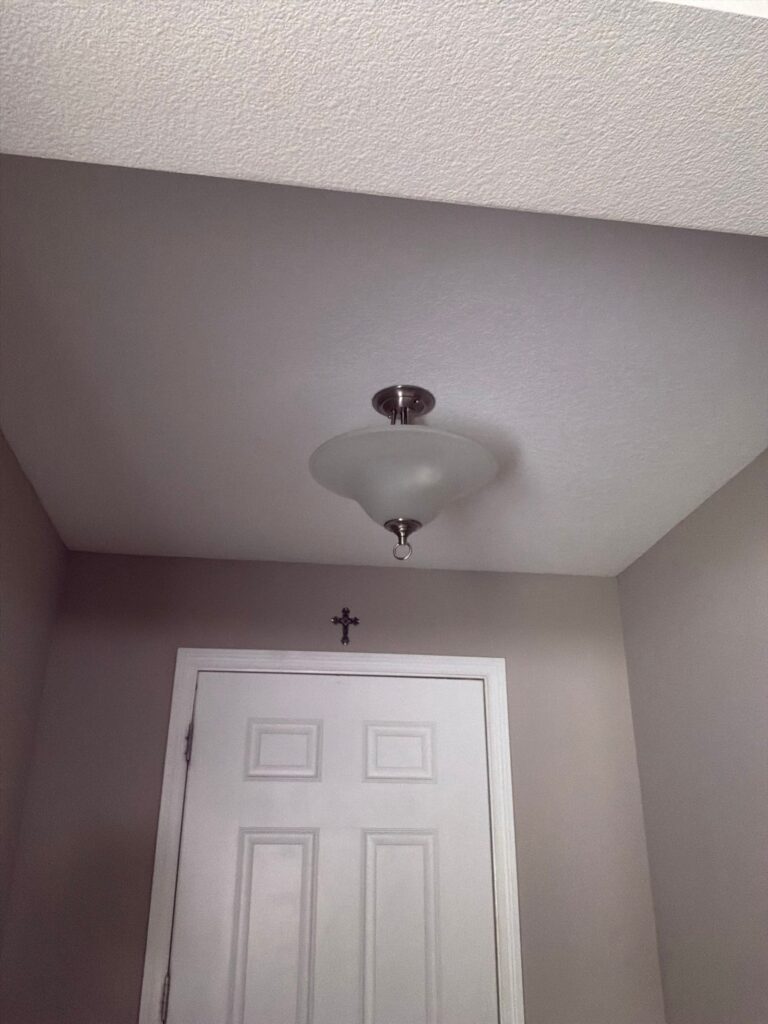
This Sanford surge protection case study walks through the real diagnosis, the fix, and the code details from a recent service call. A Sanford homeowner’s call turned into this surge damage repair job – below are the real findings and the fix, step by step. A homeowner in Sanford, FL called us after Hurricane Milton left their bathroom fan, two overhead lights, and a smoke alarm completely unresponsive. A week of guesswork was finally answered when our field team arrived, traced the damage to an unprotected power surge, and laid out a clear path to get the home running reliably again.
The Problem: A Surge Damage Repair Call in Sanford
The homeowner had gone about a week without a working bath fan or two light fixtures. The timing lined up with the passage of Hurricane Milton.
“The fan and two lights stopped working and haven’t come back on since. It’s been like this for a week.”
What looked like a simple fixture failure turned out to be a wider story, one that started at the service entrance and ended at every unprotected device in the home.
Investigation
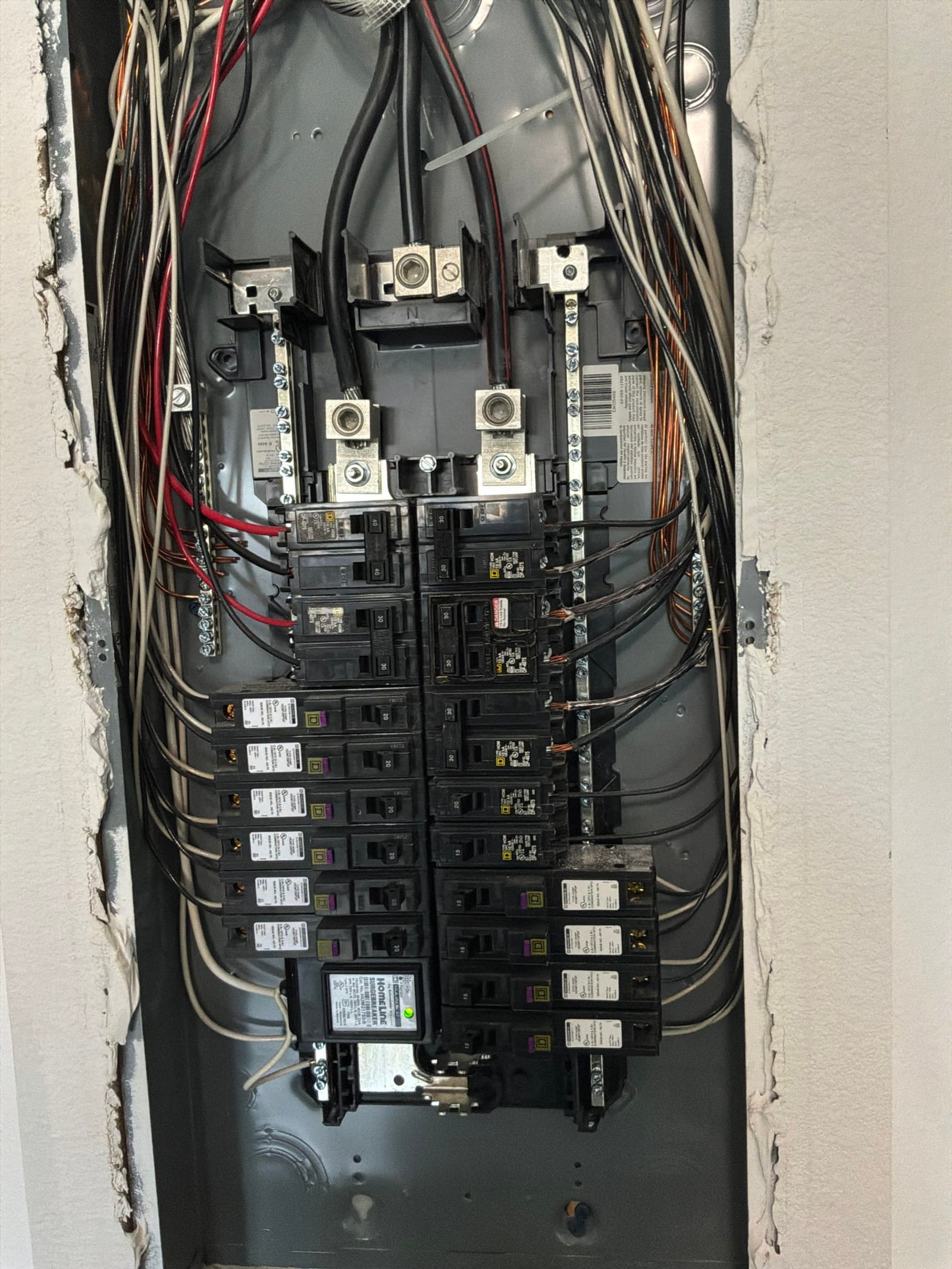
Our technician on-site began at the Eaton CH tan-handle 150-amp panel. The panel itself was in solid shape: breakers properly sized, neutrals and grounds separated, no double-tapped breakers, no open knockouts, and circuits correctly labeled. The panel was not the source of the problem.
The source was the absence of whole-home surge protection. Hurricane Milton’s grid disturbances sent voltage spikes through the service entrance with nothing to absorb them. The energy traveled downstream and reached the most sensitive devices first.
What the Surge Affected
The bath exhaust fan had taken enough voltage stress to stop operating entirely. Two LED fixtures, more sensitive to overvoltage than traditional incandescent lamps, were no longer functioning. Most critically, the interconnected smoke alarm had been knocked offline by the same event. A smoke alarm that has been through a surge event cannot be assumed to function correctly, even if it powers on intermittently.
Additional Observations
The broader inspection turned up a few items worth noting for future visits. The grounding system passed a visual check but scored a concern on full code compliance, worth reviewing on a follow-up. A handful of receptacles showed backstabbed wiring connections, a technique common in homes wired before about 2005. Several outlets were also noted as loose. Tamper-resistant receptacles were not present, and AFCI protection was partial. None of these items caused today’s failures, but they represent good candidates for a future modernization visit. No carbon monoxide detector was present in the home.
What We Fixed
Our crew removed the surge-damaged smoke alarm and documented its condition. Because the device had been exposed to a surge event, replacement, not reset, is the correct course of action. The bath fan was also identified for full replacement; surge-stressed motors rarely recover reliably.
Multiple LED fixtures damaged by the surge were flagged for replacement. LED drivers are particularly sensitive to overvoltage, and units that have been through a spike often fail intermittently before quitting entirely.
Above all, the team identified the root cause clearly: no surge protective device (SPD) at the service. Without a whole-home SPD installed at the Eaton CH panel, any future grid disturbance (another storm, a utility switching event, even a nearby lightning strike) reaches every device in the home without any buffer. Installing a Type 2 SPD at the panel, per NEC 230.67 and NEC 285.25, is the next recommended step before another storm season arrives.
Why This Sanford Surge Protection Matters for Homeowners
Central Florida homes sit in one of the most lightning-active corridors in the country. Hurricane Milton was a reminder that surge events don’t just trip breakers, they silently stress devices that seem fine until they don’t turn on one morning. For a family that relies on their smoke alarm to work every night, that’s the kind of gap worth closing.
A whole-home surge protector mounted at the panel acts as a first line of defense at the point where power enters the house. Your refrigerator, AC system, smart-home devices, televisions, and LED fixtures all benefit, not because anything is wrong with them today, but because you’d like them to keep working tomorrow, next season, and the season after that. That’s the kind of quiet reliability most households don’t think about until something stops working.
Additionally, a functioning, code-compliant smoke alarm isn’t a checkbox, it’s the device your household counts on to communicate clearly, every room at once, when it matters. Replacing a surge-damaged unit with a fresh 10-year sealed detector restores that confidence. With these items addressed, the home keeps running the way the family expects: steadily, quietly, through whatever the next storm season brings.
Thomas Edison Electric is a licensed Florida electrical contractor (EC13015487) serving the greater Orlando area, including Sanford, FL 32773. Learn more about electrical safety best practices at ESFI.org.
Code Compliance Cited in This Job
Every fix above maps to a specific section of the 2020 NEC, the edition Florida enforces under the 8th Edition Florida Building Code. Florida adopts the 2023 edition of the NEC when the 9th Edition takes effect on December 31, 2026. Each card links to NFPA’s public NEC index.
Surge Protective Device at Dwelling Service
NEC 230.67 requires a listed SPD at the service of all new dwelling units and strongly encourages it on existing services. On this job, no SPD was present at the Eaton CH 150-amp panel, leaving every device in the home exposed to the voltage spikes that accompanied Hurricane Milton. Installing a Type 2 SPD at the service entrance is the primary recommended next step. NFPA reference ›
Type 2 SPD Installation Requirements
NEC 285.25 governs how a Type 2 SPD must be installed at the load side of the service disconnect. For this Sanford home, the Eaton CH panel provides a straightforward mounting location for a compatible whole-home surge device. Proper installation ensures the SPD can clamp transient voltages before they reach branch circuits and connected equipment. NFPA reference ›
AFCI Protection for Dwelling Branch Circuits
NEC 210.12 requires arc-fault circuit-interrupter protection on branch circuits serving living areas, bedrooms, and kitchens in dwelling units. The inspection found AFCI protection to be only partially present in this home, a common condition in homes that pre-date the expanded AFCI requirements introduced in the 2014 and later NEC cycles. Completing AFCI coverage is a recommended future upgrade. NFPA reference ›
Tamper-Resistant Receptacles in Dwellings
NEC 406.12 requires tamper-resistant receptacles throughout dwelling units. The inspection confirmed that tamper-resistant outlets were not present in this Sanford home, consistent with homes wired before this requirement became broadly adopted. Replacing standard receptacles with tamper-resistant versions when outlets are updated brings the home in line with current code. NFPA reference ›
Replacement Receptacle Requirements
NEC 406.4 (D) states that when receptacles are replaced in an existing dwelling, the replacement must meet current requirements, including tamper-resistance and grounding compliance. Several outlets in this home showed loose connections and backstabbed wiring. Addressing those outlets during a future visit triggers the requirement to upgrade to compliant replacement devices at the same time. NFPA reference ›
Common Questions
Questions homeowners ask after seeing this kind of work.
Can a power surge from a hurricane really knock out LED fixtures and smoke alarms?
Yes, and it happens more often than most homeowners expect. LED drivers and the electronics inside smoke alarms are sensitive to overvoltage events. A surge that travels through an unprotected service entrance can degrade or disable these devices instantly, sometimes without tripping a single breaker. If your home went through Hurricane Milton and fixtures or detectors stopped working shortly after, a surge is the most likely explanation. Our team can book a same-day inspection to trace the damage and recommend the right repairs.
Does every Florida home need a whole-home surge protector?
NEC 230.67 now requires a surge protective device at the service of new dwelling units, and it’s a strongly recommended upgrade for existing homes, especially in Central Florida, where lightning activity is among the highest in the country. A Type 2 SPD installed at the panel protects your entire electrical system: AC, refrigerator, smart devices, LED fixtures, and more. If your home doesn’t have one yet, it’s one of the highest-value improvements you can make before the next storm season. Schedule online and we’ll assess your panel and recommend a compatible unit.
How do I know if my smoke alarm needs to be replaced after a surge?
A smoke alarm that has been exposed to a significant surge event should be replaced, not just reset, even if it appears to power on. The internal electronics may have been partially damaged in ways that aren’t visible and won’t show up until the device fails to respond when it needs to. NFPA 72 sets the standard for smoke alarm placement and performance; meeting that standard requires a fully functional device. If your alarm was active during a storm surge, schedule a safety check and we’ll confirm whether replacement is needed.
How often should I have my home’s electrical system inspected?
Once a year is a solid baseline for most households. It keeps small findings from quietly becoming larger ones. Homes built before 1990 and homes that have been through recent storm seasons like Hurricane Milton may benefit from inspections more frequently, since both aging systems and surge events can introduce changes that aren’t obvious at first glance. Book a yearly inspection and our licensed electricians will walk through the panel, circuits, and key devices so you know exactly where everything stands.
What are backstabbed outlets and should I be concerned about them?
Backstabbing was a common wiring shortcut used in homes before roughly 2005. The wire is inserted into a spring-loaded hole rather than wrapped around a screw terminal. Over time, the spring tension can ease and contact resistance climbs, which is often what causes the intermittent flickering or warm outlets homeowners notice. It doesn’t mean anything is wrong right now, but it’s an opportunity to improve connection quality the next time those outlets are serviced. Schedule an outlet inspection and our team can assess which ones are worth updating.
Curious how this compares to your own home? Learn more about our surge damage repair service.