What follows is a real wiring inspection story from Oviedo, FL: the symptoms, the diagnosis, and the finished work. A homeowner in Oviedo, FL called about two bedroom outlets that worked only sometimes, and occasionally not at all. What started as a routine outlet inspection quickly revealed something much bigger: a full studio apartment addition, a replaced Federal Pacific panel, and a significant amount of unlicensed electrical work throughout the property. Our field team documented every finding and walked the homeowner through a clear, honest picture of what the home’s electrical system looked like and what it would take to bring everything up to current standards.
The Problem
The homeowner noticed two outlets in separate bedrooms had become unreliable, intermittent power, or no power at all. They weren’t sure whether other outlets in the home shared the same issue.
“Two outlets in the bedrooms don’t work, or are very sporadic when they work. Unsure if there are others.”
That uncertainty turned out to be well-founded.
Investigation
Once our licensed electrician on site began the walkthrough, it became clear the outlet issue was a symptom of a much larger picture.
What the Home Had Become
The original single-family residence had been expanded, without permits, to include a studio apartment. Along with that addition came a 27kW tankless water heater, a mini-split air conditioning system, an EV charger, and a sub-panel installed to feed the new loads. None of this additional work appeared to have been performed by a licensed contractor or pulled through the proper permitting process.
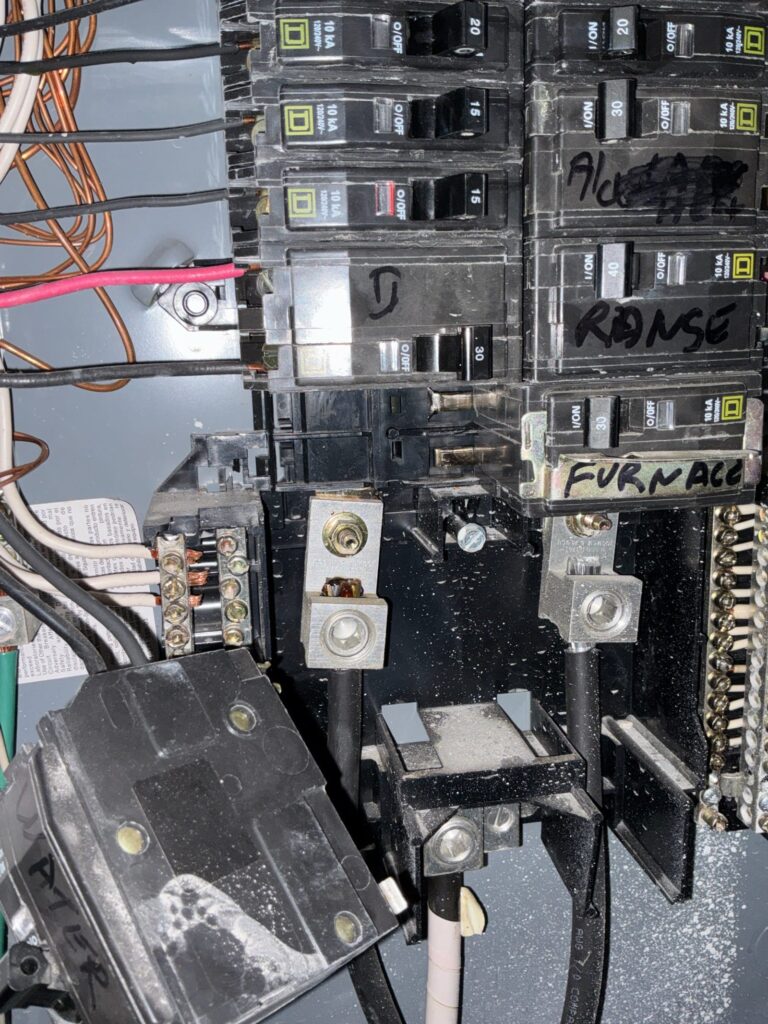
The original service panel had also been replaced at some point. The replacement is a Federal Pacific Electric (FPE) Stab-Lok panel, a brand widely recognized in the electrical industry as one that predates current reliability standards. FPE panels have been out of production for decades, and their breaker design does not meet current NEC requirements.
Conditions Found in the Load Center
The inspection of the load center turned up several findings that don’t meet current code:
- Double-tapped breakers: multiple circuits sharing a single breaker terminal, which is not permitted under NEC 110.14 (B) unless the breaker is specifically listed for it.
- Paint and rust on the busbar: a condition that increases resistance at connections and points to deferred maintenance.
- Corrosion and signs of burning on service connections: consistent with the kind of thermal stress that builds up over years of cycling under mismatched loads.
- Breakers not properly listed: some breakers installed do not carry the correct listing for the panel they’re in.
- Backstabbed outlets: spring-tension connections that lose their grip over time, which explains the intermittent behavior the homeowner described in the bedrooms.
- Open splices present in the system.
- Voltage drop on outlets confirmed during testing.
Utility Involvement
The meter can showed signs consistent with overload stress. Florida Power & Light (FPL) had already pulled the meter, meaning the home was without utility power at the time of inspection. Getting power restored will require the electrical system to be brought up to a standard that FPL and the local authority having jurisdiction (AHJ) will accept.
Missing Safety Devices
The inspection also identified several absent safety features that current code requires:
- No AFCI protection on bedroom circuits (required under NEC 210.12)
- No whole-home surge protection (NEC 230.67)
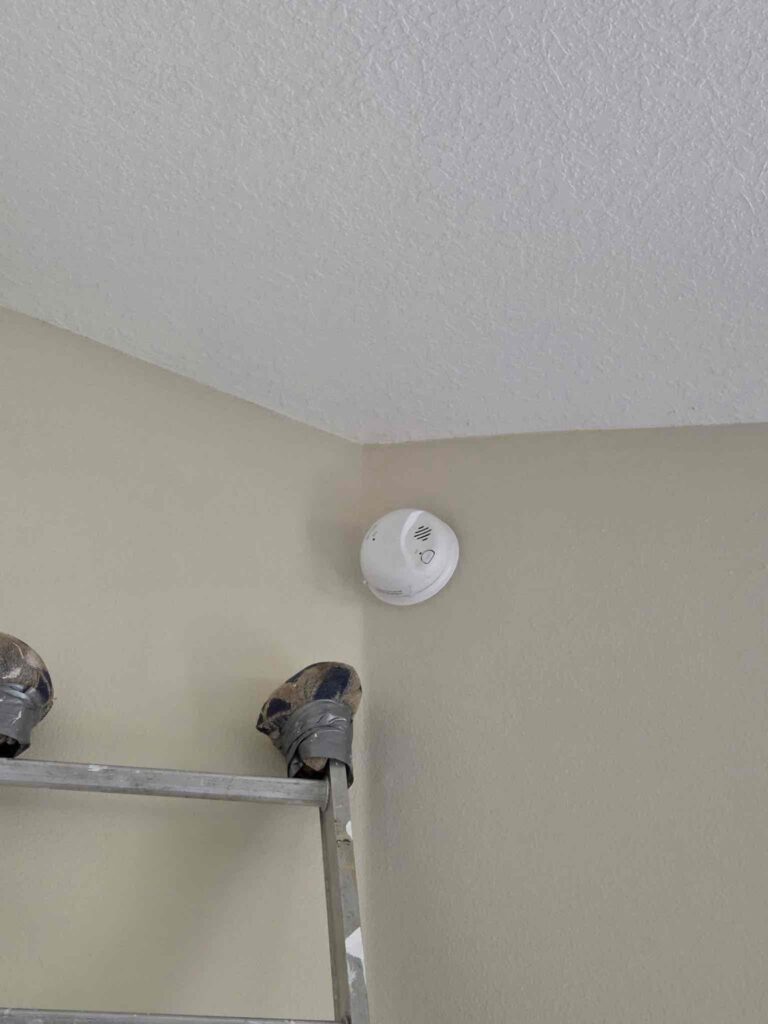
- No smoke detectors meeting current code
- No carbon monoxide detectors present
What We Fixed
Because FPL had pulled the meter and the scope of unlicensed work was extensive, this visit served as a full diagnostic inspection rather than a same-day repair call. Our field team documented every finding with photos, completed the inspection report, and provided the homeowner with a comprehensive picture of what remediation would involve.
The intermittent outlets in the bedrooms, the original reason for the call, were confirmed to trace back to backstabbed connections and voltage drop consistent with the broader wiring concerns found throughout. Correcting them in isolation, without addressing the panel and unlicensed work, would not resolve the root cause.
Next steps for this home include:
1. Coordinating with FPL to understand meter-restoration requirements 2. Consulting with the local AHJ (Orange County or City of Oviedo, depending on jurisdiction) regarding the zoning situation and permitting path 3. Full panel replacement, moving away from the FPE Stab-Lok to a modern, listed load center 4. Remediation of unlicensed wiring throughout the added studio space 5. Installation of required AFCI breakers, smoke detectors, CO detectors, and a whole-home surge protective device
Our team is licensed with the State of Florida (EC13015487) and can guide the homeowner through the permitting and inspection process from start to finish.
Why This Wiring Inspection Matters for Oviedo Homeowners
For a family living in a home like this one, reliability starts with knowing that every part of the electrical system was installed correctly and inspected by the proper authorities. When additions are made without permits, the electrical, structural, and zoning pieces don’t go through the checks that protect the household, and the results can quietly affect everyday life in ways that aren’t always obvious at first.
Intermittent outlets are easy to overlook. However, when those outlets trace back to backstabbed connections, an aging FPE panel, and a sub-panel feeding loads the original service wasn’t designed for, the whole home deserves attention, not just the two bedrooms that prompted the call.
Additionally, homes with unpermitted work face real challenges at closing. Buyers, lenders, and insurers all rely on permit history to understand what’s been done to a property. Getting the work permitted and inspected now protects the homeowner’s investment and gives the whole household the peace of mind that comes from knowing everything was done right. When the panel is modernized, the circuits are properly protected, and the system is signed off by a licensed inspector, the family can go about their morning routine (coffee, school drop-offs, charging devices) without wondering whether the wiring behind the walls is keeping up.
For more guidance on electrical safety for homeowners, the Electrical Safety Foundation International offers plain-language resources that are worth a read.
Code Compliance Cited in This Job
Every fix above maps to a specific section of the 2020 NEC, the edition Florida enforces under the 8th Edition Florida Building Code. Florida adopts the 2023 edition of the NEC when the 9th Edition takes effect on December 31, 2026. Each card links to NFPA’s public NEC index.
Electrical Connections
NEC 110.14 (B) requires that terminals be used only for the conductor material and number of conductors listed for that terminal. On this job, double-tapped breakers were found where the breakers were not listed for multiple conductors, a condition that increases resistance at the terminal and contributes to intermittent circuit performance. Correcting this means either installing listed tandem breakers or adding circuits through a properly sized panel. NFPA reference ›
AFCI Protection
NEC 210.12 requires arc-fault circuit-interrupter protection on all 120V, 15A and 20A branch circuits supplying outlets in dwelling-unit bedrooms, living rooms, kitchens, and similar areas. This home had no AFCI protection present, consistent with a panel that predates the requirement. Adding AFCI breakers as part of the panel remediation will bring the bedroom circuits up to current standards. NFPA reference ›
Surge Protective Devices: Dwelling Services
NEC 230.67 requires a listed surge protective device (SPD) to be installed at the service of all newly installed services for dwelling units. No surge protection was present on this property. As part of any panel replacement, a Type 1 or Type 2 SPD should be installed to protect the home’s appliances, electronics, and newly added equipment, including the EV charger and mini-split, from voltage transients. NFPA reference ›
Type 2 SPD Installation
NEC 285.25 governs the installation requirements for Type 2 surge protective devices installed on the load side of the service disconnect. Given the high-value loads added to this property (a 27kW tankless water heater, mini-split, and EV charger), a properly installed Type 2 SPD at the new panel will help those systems ride through transient events without interruption. NFPA reference ›
Circuit Directory and Identification
NEC 408.4 requires every circuit in a panelboard to be legibly identified as to its purpose or use, and that the identification be marked on a directory inside the panel door. With a sub-panel added for the studio addition and multiple new circuits, ensuring all circuits are accurately labeled is a foundational step in the remediation process, both for safety and for passing inspection. NFPA reference ›
Replacement Receptacles
NEC 406.4 (D) specifies that when receptacles are replaced, they must meet current requirements, including tamper-resistance and GFCI protection where applicable. The backstabbed outlets found in the bedrooms will need to be replaced with properly terminated, code-compliant devices as part of the overall remediation, ensuring reliable contact and meeting today’s standards. NFPA reference ›
Common Questions
Questions homeowners ask after seeing this kind of work.
Why would two bedroom outlets be intermittent even though the breaker hasn’t tripped?
Intermittent outlets that don’t trip a breaker are often traced to poor connections at the outlet itself, most commonly backstabbed wiring, where the conductor is held by a spring clip instead of a screw terminal. Over time, spring tension eases and contact resistance rises, which causes the outlet to work sometimes and not others. Voltage drop at the outlet confirmed this on this job. If you’re seeing the same pattern at home, a licensed electrician can test the circuit and replace the outlet with a properly terminated device. Schedule online to get it checked.
What happens when FPL pulls a meter, and how does a homeowner get power restored?
When Florida Power & Light removes a meter, it’s typically because a condition was found at the meter can or service entrance that they determined needed to be addressed before power could safely remain connected. Restoration requires a licensed electrical contractor to correct the identified issues, pull the appropriate permits, and pass an inspection by the local authority having jurisdiction (AHJ). FPL then re-installs the meter after receiving clearance. This process can take days to weeks depending on the scope of work and permit scheduling. If your meter has been pulled or you’ve received a notice from FPL, schedule online so our team can start the path to restoration.
Is a Federal Pacific Electric (FPE) Stab-Lok panel something I should replace?
FPE Stab-Lok panels were manufactured from the 1950s through the 1980s and are no longer in production. The breaker design used in these panels does not meet current listing standards, and industry research has raised questions about their reliability over decades of use. Most licensed electricians and home inspectors recommend replacement when one is found, particularly when the home is being updated or when new loads are being added. Replacing an FPE panel gives the household a modern, properly listed load center with room for today’s circuits. Schedule online for an assessment if your home has an FPE panel.
How often should I have my home’s electrical system inspected?
A thorough electrical inspection once a year is a reasonable baseline for most homes. Older homes, particularly those built before 1990, and homes that have weathered recent storms, added new appliances, or had any work done without permits may benefit from inspections more frequently. Annual inspections give a licensed electrician the chance to catch small issues before they become larger ones, and they keep the homeowner informed about where the system stands relative to current code. Schedule online to get your annual inspection on the calendar.
What are the risks of unpermitted electrical work when selling a home?
Unpermitted electrical work can affect a home sale in several ways. Buyers’ lenders and insurers often require permit histories to be clean, and a home inspection will typically flag unpermitted additions. In some cases, the buyer can require the seller to remediate the work, including pulling retroactive permits and passing inspections, before closing. Addressing unpermitted work proactively, with a licensed contractor and proper permits, protects the homeowner’s equity and avoids surprises at closing. Our team can assess the scope and walk you through the permitting process. Schedule online to start that conversation.
Want to see more real jobs like this one? Browse our completed case studies or explore our services.