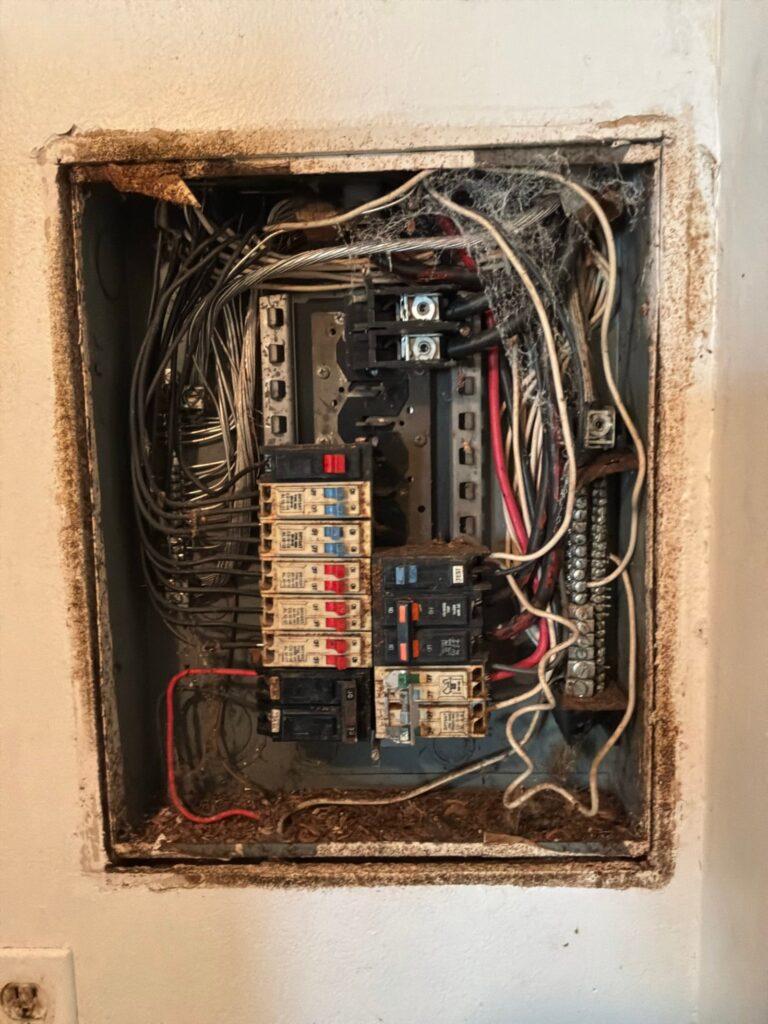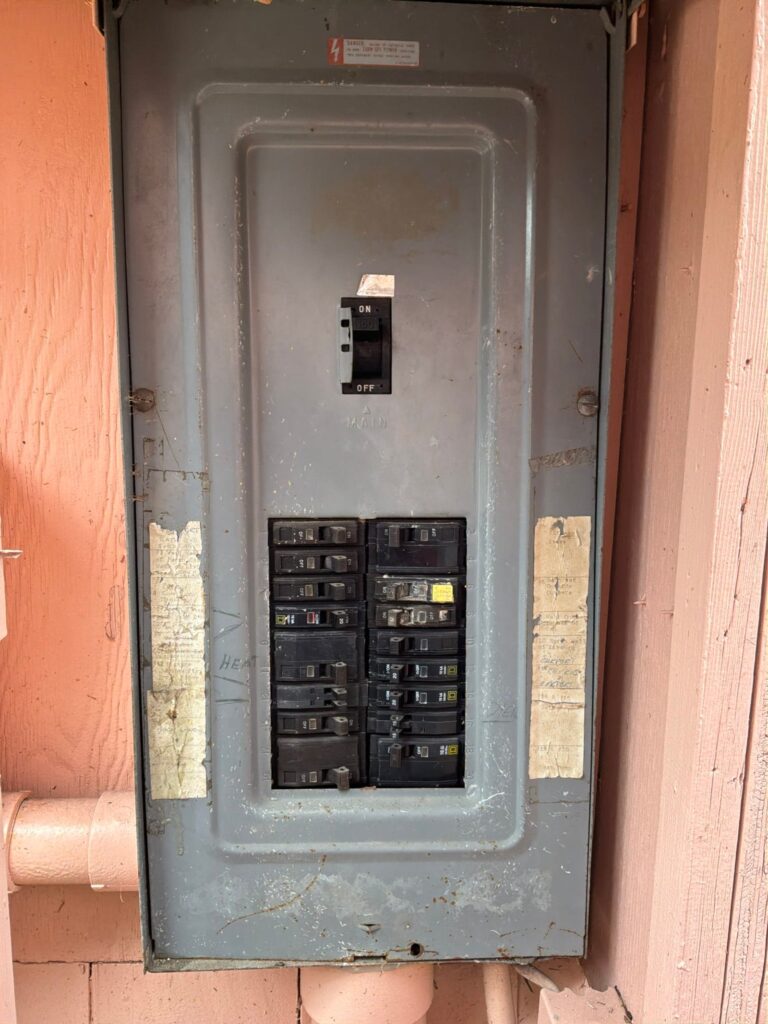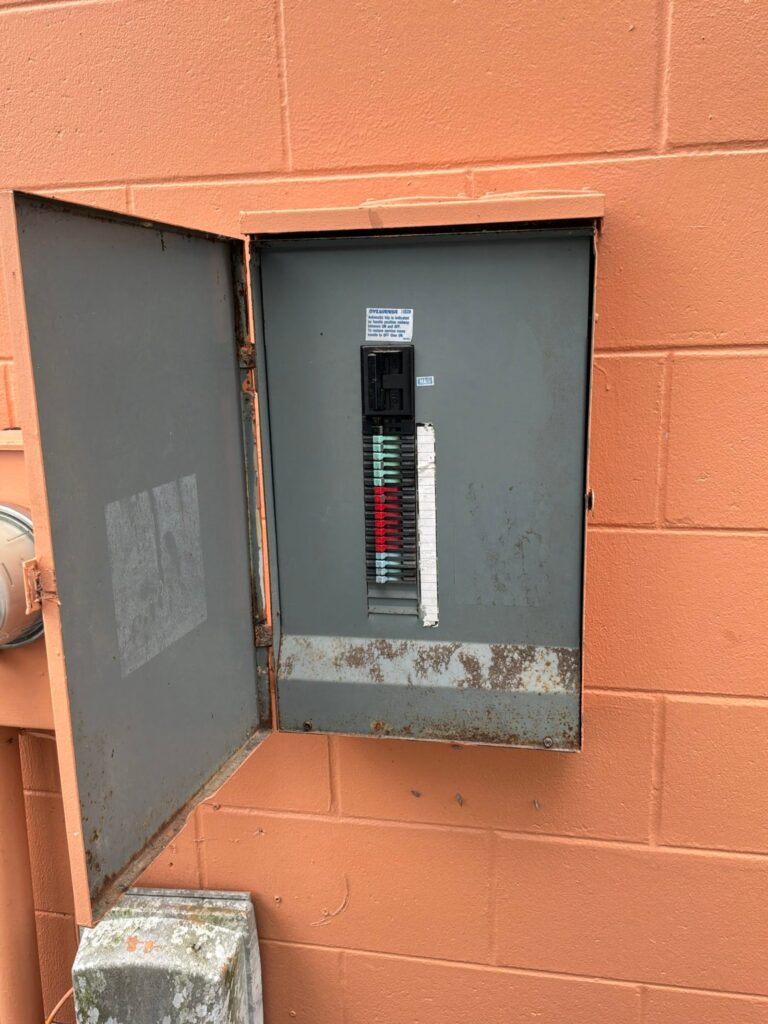
This case study follows a real panel repair job at an Orlando, FL home – what we checked, what we found, and how we fixed it. A homeowner in Orlando, FL (32810) reached out about a non-working kitchen outlet near the garbage disposal. Our field team arrived, checked the outlet, and then ran a full panel and whole-home inspection. What they found in the Square D QO 200-amp service panel, and throughout the home, pointed to several areas ready for modernization.
The Problem
The immediate concern was simple: the garbage disposal outlet had stopped working. However, once our crew was on-site, the inspection uncovered a wider picture of items that had drifted out of step with current code standards.
“One of the kitchen outlets isn’t working. We’d like it fixed, and we want to know what else might need attention in the panel.”
Investigation
Our technician on-site started at the Square D QO 200-amp panel and worked outward through the home. The panel itself is a solid platform: neutrals and grounds were properly separated, the main breaker was correctly sized, the meter can was in good condition, and the weatherhead mounting looked sound. AFCI protection, circuit labeling, and breaker sizing all passed without concern.
That said, several items flagged for follow-up:
Panel-Side Findings
The inspection revealed double-tapped breakers, two branch-circuit conductors landed on terminals designed for one. This is a wiring practice that predates modern panel standards; today’s code calls for each conductor to have its own dedicated terminal, or for a listed tandem breaker when two circuits genuinely need to share a slot. Additionally, open knockouts were present in the enclosure, leaving gaps in the panel’s interior protection. The inspection also documented paint or rust on the busbar and evidence of corrosion or burning on internal components, consistent with a panel that has seen years of Florida humidity cycling through it.
Finally, no whole-home surge protection was installed. Florida’s lightning season is long, and the panel had no Type 2 SPD standing between the grid and the home’s appliances, electronics, and HVAC equipment.
Branch-Circuit and Outlet Findings
Back in the kitchen, the technician confirmed the root cause of the dead outlet. The kitchen outlets lacked GFCI protection, a requirement under today’s code that wasn’t standard when the home was wired. Several outlets also showed signs of backstabbing (spring-clip terminations rather than screw terminals) and general wear. Voltage drop was measurable at receptacles, which can affect appliance performance over time.
Smoke detectors and the grounding system were also noted for attention. The detectors predated current interconnect requirements under NFPA 72, and the grounding system showed signs of age that warranted a closer look.
What We Fixed
At this visit, our team investigated and documented all findings and presented the homeowner with a full set of options. The homeowner, who was out of the country and coordinating remotely, reviewed the findings and indicated he would schedule the repair work at a later date.
Our recommendations for next steps include:
- Resolve the double-tapped breakers by installing properly listed tandem breakers or adding a sub-feed, so every conductor has a dedicated, code-compliant termination
- Seal all open knockouts with listed filler plates per current panel enclosure requirements
- Address busbar rust and internal corrosion: cleaning or replacing affected components to restore clean electrical contact
- Install a Type 2 whole-home surge protective device (SPD) at the panel, such as a PSP Vortex or equivalent listed device, to bring the service in line with NEC 230.67
- Add GFCI protection to all kitchen and required-area outlets, replacing backstabbed devices with properly screw-terminated GFCI receptacles
- Update smoke and CO detectors to interconnected units that meet current NFPA 72 requirements
- Evaluate and modernize the grounding system to confirm it meets current NEC 250 standards
Why This Panel Repair Matters for Orlando Homeowners
A 200-amp Square D QO panel is a capable, well-regarded platform. When the panel itself is in good shape, targeted repairs (fixing double-taps, sealing knockouts, cleaning corrosion), can bring it fully in line with current code without a full replacement. That means the home’s electrical backbone keeps doing its job reliably, season after season.
The missing surge protection is worth putting near the top of the to-do list. Additionally, a whole-home surge protective device installed at the panel means the family’s refrigerator, AC unit, smart-home devices, and computers are all covered the moment a surge travels in from the grid, without anyone having to think about it. Every storm, every afternoon lightning strike, every neighborhood grid fluctuation: the device handles it quietly in the background.
For a household running a modern kitchen, the GFCI upgrades matter for everyday comfort, too. Properly terminated, GFCI-protected kitchen outlets work the way the family expects, no nuisance trips from aging spring connections, no dead outlets interrupting meal prep or the morning routine. Furthermore, bringing smoke detectors up to NFPA 72 interconnect standards means every room in the home communicates, so the whole household is aware the moment any detector activates, not just the room it’s in. That’s the kind of quiet, behind-the-scenes reliability that lets a family focus on daily life rather than worry about what’s inside the walls.
Code Compliance Cited in This Job
Every fix above maps to a specific section of the 2020 NEC, the edition Florida enforces under the 8th Edition Florida Building Code. Florida adopts the 2023 edition of the NEC when the 9th Edition takes effect on December 31, 2026. Each card links to NFPA’s public NEC index.
Terminal Connections
Double-tapped breakers, two conductors landed on a single-conductor terminal, don’t meet the connection requirements of NEC 110.14 (B). On this job, affected circuits need dedicated terminals or properly listed tandem breakers to restore compliant, low-resistance connections. NFPA reference ›
Unused Panel Openings
Open knockouts in the panel enclosure leave the interior exposed to debris, pests, and contact. NEC 408.7 requires all unused openings in panelboards to be closed with listed filler plates, a quick fix that restores the enclosure’s integrity. NFPA reference ›
Surge Protective Device at Services
NEC 230.67 requires a listed SPD at the service of all new and replacement dwelling-unit services. This home currently has no whole-home surge protection; installing a Type 2 SPD at the Square D QO panel directly satisfies this requirement and protects connected equipment from transient overvoltages. NFPA reference ›
Type 2 SPD Installation
When the SPD is installed, NEC 285.25 governs the specifics: the device must be listed, connected to the load side of the service disconnect, and installed with conductors kept as short as practical. This is the companion section to NEC 230.67 that guides the physical installation details. NFPA reference ›
GFCI Protection for Personnel
Kitchen receptacles, including the garbage disposal outlet, require GFCI protection under NEC 210.8. The home’s kitchen outlets predate this requirement; replacing them with listed GFCI receptacles using screw-terminal connections brings the circuits into full compliance with current standards. NFPA reference ›
Replacement Receptacle Requirements
When receptacles are replaced in an existing dwelling, NEC 406.4 (D) requires the new devices to meet current requirements, including GFCI protection where applicable and tamper-resistant construction. Replacing the backstabbed, worn kitchen outlets is the right opportunity to bring all replaced devices up to today’s standard. NFPA reference ›
Common Questions
Questions homeowners ask after seeing this kind of work.
What are double-tapped breakers and why do they need to be corrected?
A double-tapped breaker has two separate circuit conductors landed on a terminal that the manufacturer listed for only one. Over time, the connection can loosen, leading to the kind of intermittent voltage drop and wear that shortens the life of the breaker and the connected wiring. Most Square D QO breakers accept only one conductor per terminal; the fix is either a listed tandem breaker (designed for two circuits in one slot) or a dedicated breaker for each circuit. If your panel has double-taps, our team can assess the right solution during a same-day visit, schedule online to get on the calendar.
Why does a whole-home surge protector matter more than individual plug-in strips?
Plug-in surge strips protect only the devices plugged into them, and they can’t protect hardwired equipment like your AC compressor, well pump, or oven. A Type 2 SPD installed at the main panel covers every circuit in the home simultaneously, so a lightning-induced surge on the grid doesn’t reach any appliance or system before it’s clamped. In Florida, where afternoon thunderstorms are a near-daily event in summer, panel-level protection is the most complete solution available. Schedule online and ask about whole-home surge protection during your next inspection.
How often should I have my home’s electrical system inspected?
A yearly inspection is a solid baseline for most homes. It keeps you current with any changes in code and catches small issues before they grow. Older homes built before 1990 and homes that have come through a busy storm season may benefit from inspections more frequently, since age and weather cycling can accelerate wear on connections, breakers, and grounding components. Our team is happy to walk through the full system with you and prioritize any findings. Book a safety check to get started.
What does rusty or corroded busbar material mean for a panel?
The busbar is the conductive bar inside the panel that distributes power to each breaker. Surface rust or corrosion increases resistance at those contact points, which can cause uneven current distribution and extra thermal stress on the affected connections over time. In many cases, the corrosion can be cleaned and the affected terminations re-torqued. In more advanced situations, replacing the busbar or the panel itself is the more reliable long-term path. Either way, it’s worth having a licensed electrician evaluate the extent before the next rainy season. Schedule online for an assessment.
Are backstabbed outlets a concern in an older home?
Backstabbing, using the spring-clip holes on the back of a receptacle rather than the screw terminals on the side, was a common installation shortcut through much of the 1980s and 1990s. The spring tension in those clips tends to ease over years of use, raising contact resistance and producing the kind of intermittent outlet failures and voltage drop this homeowner experienced. Replacing backstabbed devices with properly screw-terminated receptacles is a straightforward repair that restores consistent, reliable performance. Unsure whether your outlets were backstabbed? Our team can book a quick visual inspection and give you a clear answer.
Want to see more real jobs like this one? Browse our completed case studies or explore our services.