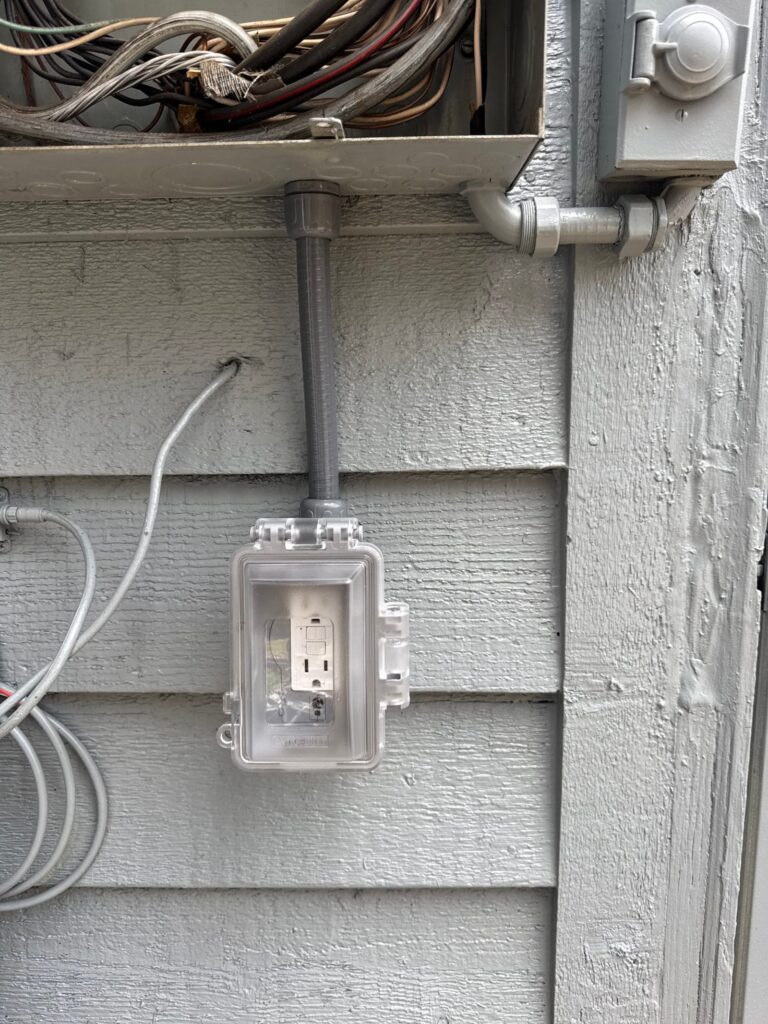
This case study follows a real GFCI outlet repair job at an Orlando, FL home – what we checked, what we found, and how we fixed it. A homeowner in Orlando, FL (32817) called us when the outlet powering their garbage disposal went dead. What started as a single non-working outlet turned into a full-picture inspection, one that revealed several areas where the home’s wiring predates the 2020 NEC requirements Florida enforces. Our field team documented every finding, walked the homeowner through the options, and left them with a clear path forward.
The Problem
The day started simply enough.
“The outlet under the sink stopped working and I can’t run the garbage disposal.”
That kind of call is common, and the fix is often quick. However, our crew always treats a dead outlet as an invitation to look at the bigger picture, because the root cause is rarely just the one device.
Investigation
Our technician on-site started at the non-working kitchen outlet and worked outward from there.
What the Outlet Inspection Revealed
The field team confirmed that one kitchen outlet had lost power entirely. Additionally, and more importantly for the long run, none of the kitchen outlets carried GFCI protection, a requirement under NEC 210.8 for all kitchen countertop receptacles. The home’s Square D QO 125-amp panel itself was in solid shape: breakers properly sized, no double-tapped conductors, no open knockouts, panel directory clearly labeled. That’s good news. The panel is a reliable foundation to build from.
Backstabbed Connections
The inspection also turned up backstabbed outlet connections throughout the kitchen. Backstabbing, pushing the wire into the back-clamp hole rather than wrapping it under a screw terminal, was a common shortcut in homes wired before roughly 2005. Over time, the spring tension in those back-clamps relaxes, contact resistance climbs, and you get exactly the kind of intermittent or complete power loss the homeowner described. Replacing them with proper screw-terminal connections is a straightforward, durable fix under NEC 110.14 (B).
Grounding System
The grounding system registered as a concern on the inspection checklist, not a failure, but worth noting. The outlets themselves showed proper grounding, and the panel grounding electrode system was present. Still, the grounding infrastructure is approaching the point where a full review and possible update would bring the home into alignment with NEC 250.50 requirements. This is consistent with homes of this era.
Additional Findings
Three other items came up during the broader inspection:
- Smoke detectors do not meet current NFPA 72 standards: a straightforward upgrade to 10-year sealed lithium interconnected smoke/CO combination detectors would bring the home current.
- No whole-home surge protection was present. A PSP Vortex or comparable Type 2 SPD at the Square D QO panel would protect the home’s appliances and electronics under NEC 230.67.
- AFCI protection was not present on living-area branch circuits, which predates the current NEC 210.12 requirement.
What We Fixed
After presenting the full findings, the homeowner decided to hold off on scheduling the work and address the items on his own timeline. Our crew respected that completely. The visit delivered a thorough, documented inspection with clear recommendations, so when he’s ready, there’s no guesswork involved. The full list of recommended work includes:
- Restore power to the dead kitchen outlet
- Replace all kitchen outlets with GFCI-protected devices and convert backstabbed connections to screw-terminal
- Re-device outlets and switches throughout the home
- Install interconnected smoke/CO detectors to current NFPA 72 standards
- Review and update the grounding system
- Add a Type 2 whole-home surge protector at the Square D QO panel
- Evaluate AFCI protection for applicable branch circuits
Why This GFCI Outlet Repair Matters for Orlando Homeowners
For most families, the kitchen is the busiest room in the house, morning coffee, after-school snacks, weekend dinners. When an outlet goes out, it’s not just inconvenient; it’s a signal worth listening to. In this home, that one quiet outlet led to a fuller picture of where the electrical system stood relative to today’s standards.
For example, GFCI protection in kitchens has been required since the early 1970s and has been steadily expanded in every code cycle since. Homes that were wired before recent updates may simply not have it, and that’s not a reflection on the original builder. It’s just how codes evolve. Bringing those outlets current means the kitchen works the way a modern kitchen should: reliably, every single day, without a second thought.
Surge protection is another item that rewards the whole household quietly. Orlando sees more lightning strikes per year than almost anywhere in the country. A whole-home Type 2 SPD at the panel means the refrigerator, AC, computers, and televisions ride through every summer storm without skipping a beat. The family doesn’t have to think about it, and that’s exactly the point.
Above all, a licensed electrical inspection gives homeowners peace of mind. Knowing what’s current, what predates current code, and what can wait, on a documented timeline, means no surprises. Our team is licensed through the Florida Department of Business & Professional Regulation (EC13015487), and every inspection follows the 2020 NEC standards Florida enforces so the findings mean something you can act on with confidence.
Code Compliance Cited in This Job
Every fix above maps to a specific section of the 2020 NEC, the edition Florida enforces under the 8th Edition Florida Building Code. Florida adopts the 2023 edition of the NEC when the 9th Edition takes effect on December 31, 2026. Each card links to NFPA’s public NEC index.
GFCI Protection for Personnel
NEC 210.8 requires GFCI protection on all kitchen countertop receptacles in dwelling units. The kitchen outlets in this Orlando home lacked this protection entirely, consistent with wiring that predates the most recent code cycles. Adding GFCI devices brings every countertop circuit into compliance. NFPA reference ›
Terminal Connections
NEC 110.14(B) requires that conductors be connected using listed methods that maintain reliable contact. The backstabbed connections found in this kitchen rely on spring-clamp tension that eases over time, increasing contact resistance. Re-terminating under screw terminals restores a solid, code-compliant connection. NFPA reference ›
AFCI Protection
NEC 210.12 requires arc-fault circuit-interrupter protection on branch circuits serving dwelling-unit living areas, bedrooms, kitchens, and other spaces. This home’s circuits predate that requirement. Adding AFCI breakers at the Square D QO panel would bring those circuits to current standards. NFPA reference ›
Surge Protective Device at Service
NEC 230.67 requires a listed surge protective device at the service equipment for new and replacement services in dwelling units. No whole-home SPD was present at this 125-amp Square D QO panel. Installing a Type 2 SPD here addresses that gap and protects connected appliances and electronics. NFPA reference ›
Grounding Electrode System
NEC 250.50 establishes what electrodes must be bonded into a complete grounding electrode system. The inspection flagged the grounding infrastructure as a concern, present but approaching the point where a full review is warranted. Updating it ensures the system meets current code in full. NFPA reference ›
Common Questions
Questions homeowners ask after seeing this kind of work.
Why would a kitchen outlet stop working even if the breaker hasn’t tripped?
Backstabbed connections are one of the most common culprits. When a wire is pushed into the back-clamp rather than secured under a screw terminal, the spring tension slowly relaxes over years of use. Eventually, the connection becomes intermittent or fails completely, even though the breaker is fine. A quick inspection at the outlet itself usually confirms the cause. Schedule online and our team can trace the fault and replace the connection the same day.
How do I know if my kitchen outlets are GFCI protected?
Look for the TEST and RESET buttons on the outlet face, that’s the most visible sign. Alternatively, a GFCI breaker in your panel may protect the entire circuit even if the outlets themselves look standard. Homes built or last renovated before the early 1990s often lack kitchen GFCI protection entirely, since code requirements have expanded over multiple cycles. If you’re unsure, our team can book a 30-minute visual inspection and give you a clear answer.
How often should I have my home’s electrical system inspected?
Once a year is a solid baseline for most homes. Older homes built before 1990, or any home that has weathered a significant storm season, can benefit from more frequent check-ins, conditions change, and what looked fine last year may have shifted. An annual inspection catches small concerns before they become bigger ones and keeps your documentation current. Schedule online to put a yearly inspection on the calendar.
Is whole-home surge protection worth adding to an existing panel?
For homes in the Orlando area, it’s one of the highest-value upgrades available relative to what it protects. A Type 2 SPD installed at the panel guards every circuit in the home (refrigerator, AC, computers, televisions) against the voltage spikes that come with Central Florida’s frequent summer lightning. The install is straightforward on a Square D QO panel and typically takes under an hour. Book a surge-protection estimate to see what’s involved for your specific setup.
What does it mean when an inspector says my smoke detectors are not up to code?
NFPA 72 sets the placement, interconnection, and device-age standards for smoke and CO detectors. Older detectors, typically any unit over 10 years old, may no longer sense reliably, and homes that lack interconnected detectors mean only one room gets an alert if something changes elsewhere. Upgrading to 10-year sealed lithium interconnected smoke/CO combination detectors brings the home to current NFPA 72 standards so every room in the house is aware at the same moment. If your detectors are overdue, our team can schedule a detector replacement visit at your convenience.
Want to see more real jobs like this one? Browse our completed case studies or explore our services.