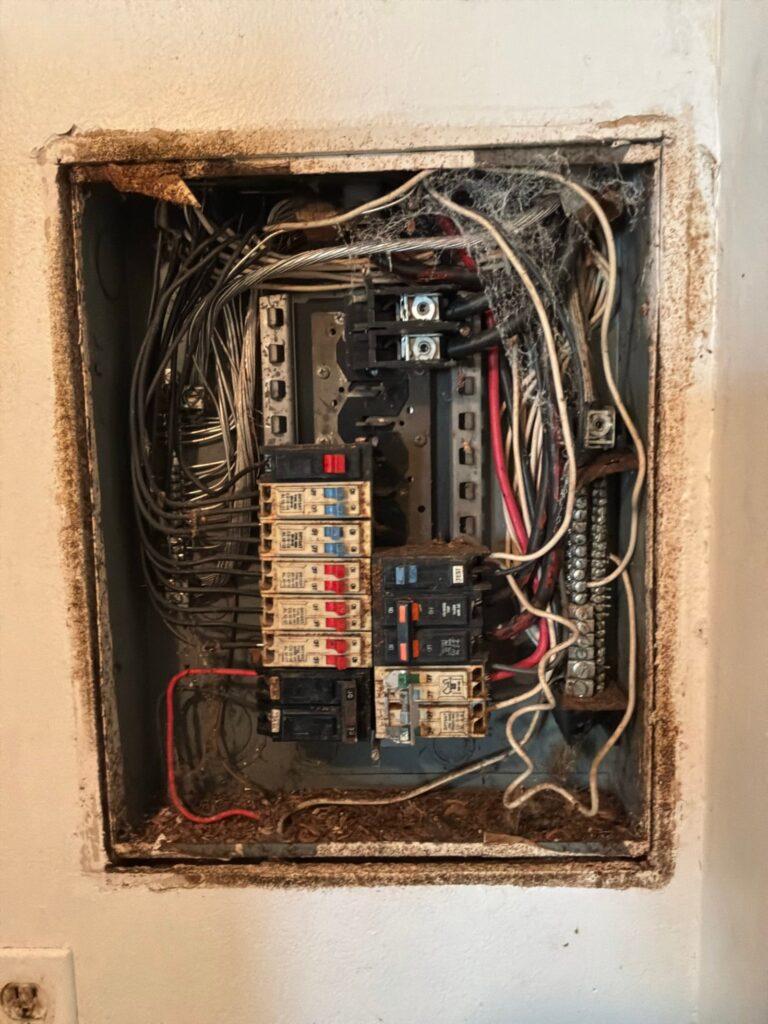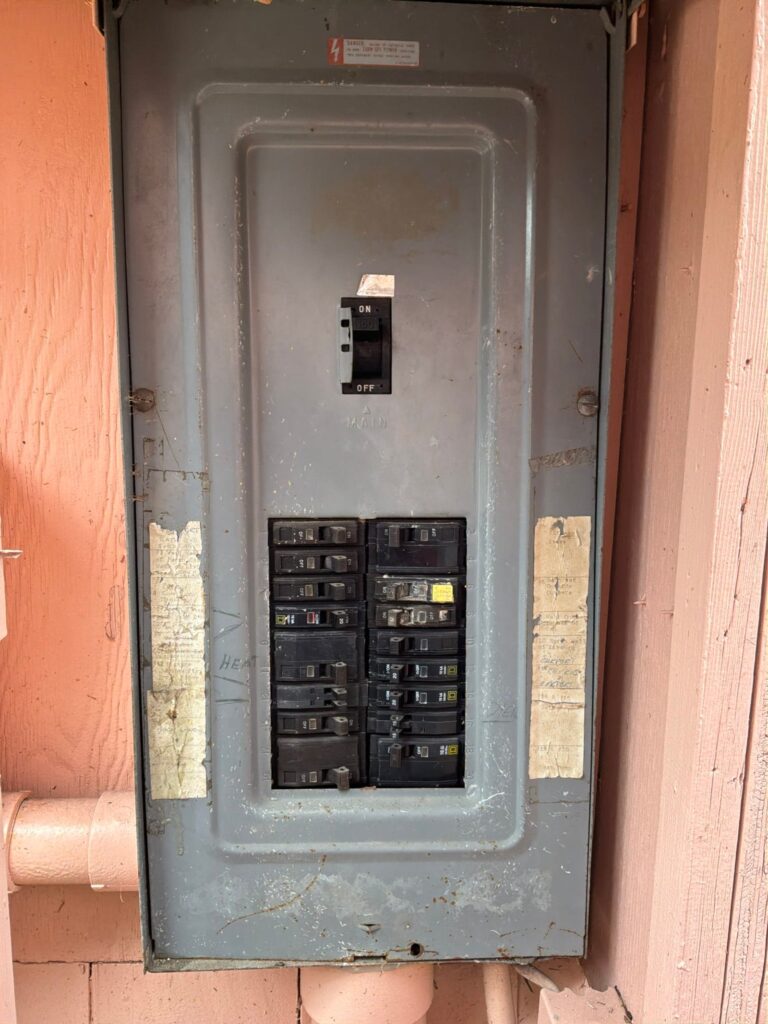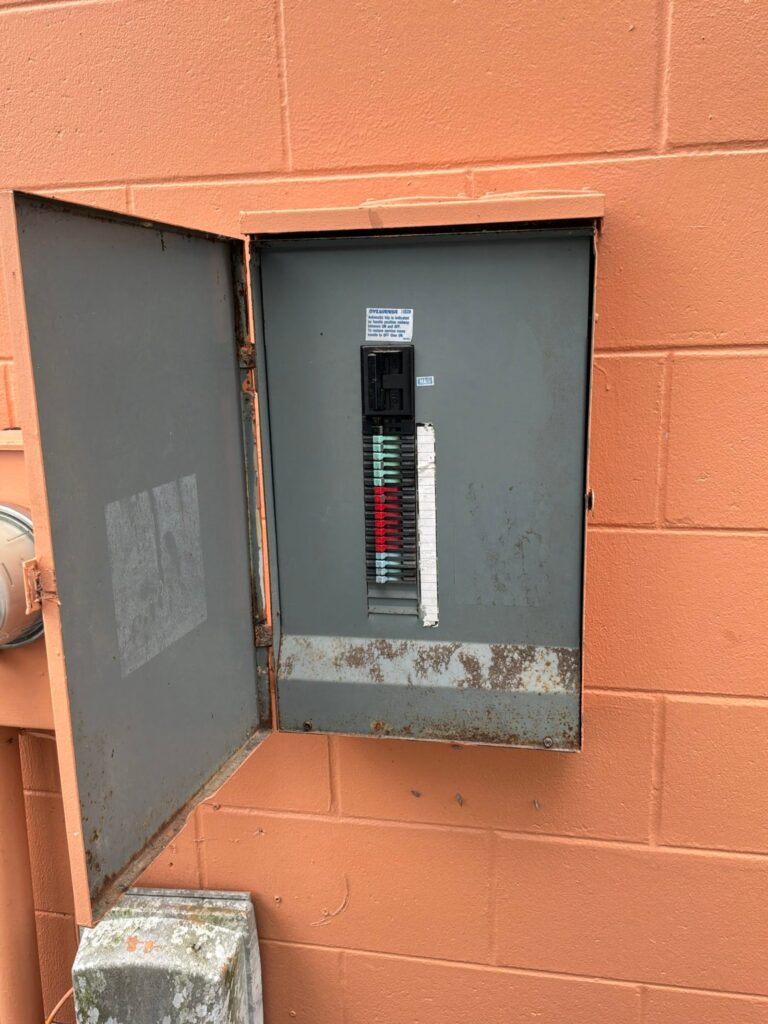
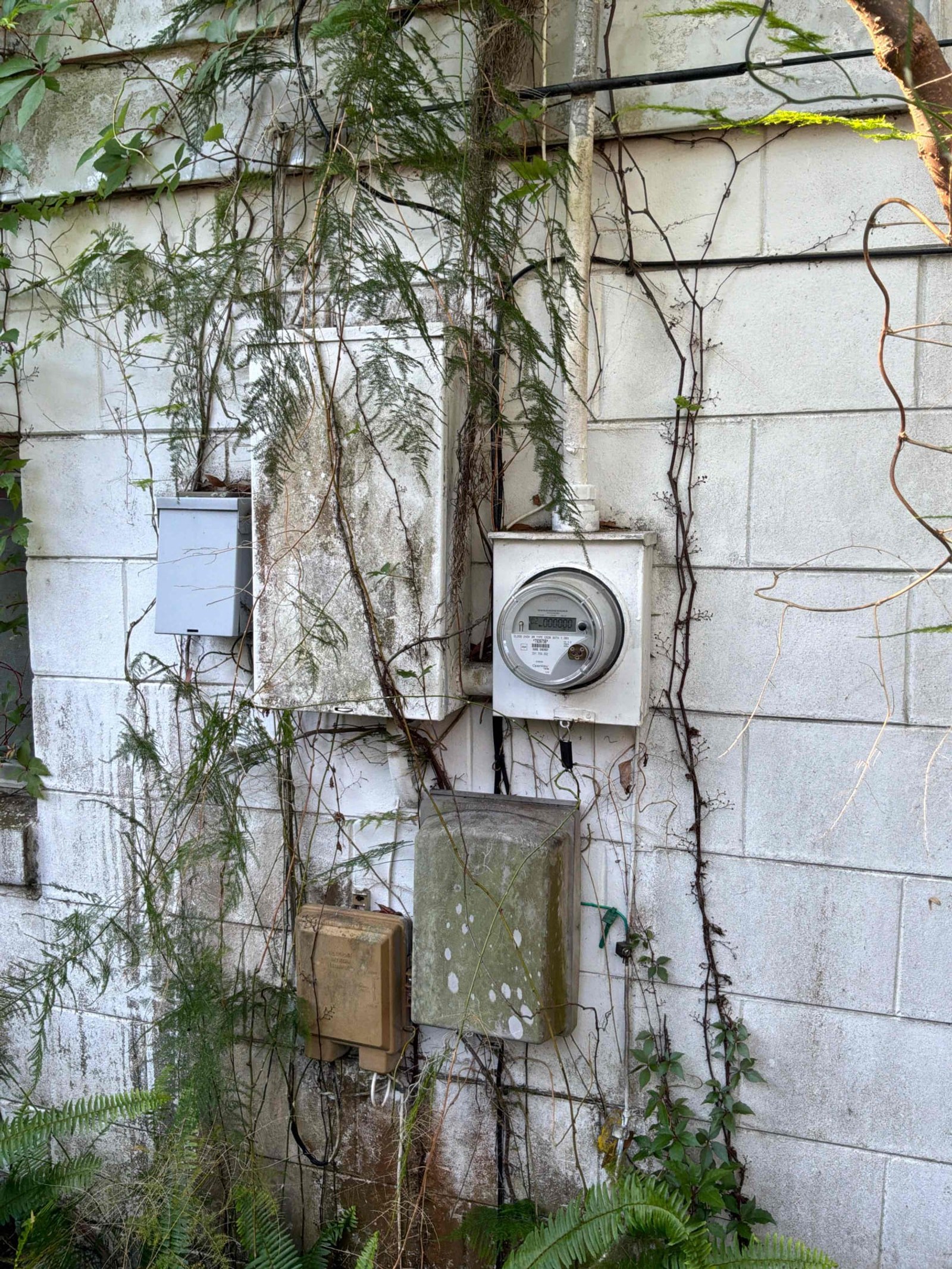
A Belle Isle homeowner’s call turned into this panel replacement job – below are the real findings and the fix, step by step. A homeowner in Belle Isle, FL called us after a whole-home safety check turned up four specific findings worth addressing. Our field team completed a thorough inspection of the existing 200-amp GE panel and surrounding systems, then mapped out a plan to modernize the entire electrical service, from the meter center down to individual outlet connections. The result is a home whose electrical system now matches both the family’s current needs and current NEC standards.
The Problem
The homeowner wanted to understand the true condition of their electrical system before committing to any upgrades. After our licensed electrician on site completed the visual safety check, a clear picture emerged:
“We found four areas that had moved beyond what current code recommends: no surge protection, an open knockout in the panel, backstabbed outlet connections throughout the home, and a grounding system that relied on a single ground rod.”
None of these conditions were unusual for a home of this era. Each one, however, represented a straightforward opportunity to bring the system fully up to date.
Investigation
The inspection checklist told a balanced story. Most of the system scored green: neutrals and grounds were properly separated, breakers were correctly sized, GFCI protection was present in required areas, smoke and carbon monoxide detectors were in place, and there was no corrosion or burning anywhere on the service. That’s a solid foundation.
Four items, however, came back as concerns or failed checks:
Single ground rod. Our technician on-site could visually identify only one ground rod at the service. Current code (NEC 250.52 and 250.53) requires a grounding electrode system with at minimum two ground rods spaced at least 6 feet apart, or an equivalent supplemental electrode. A single rod is consistent with older installation practices but doesn’t meet today’s standard.
No surge protection. The home had no whole-house surge protective device, a finding that matters more each year as homes fill with sensitive electronics, smart appliances, and variable-speed HVAC equipment. NEC 230.67 now requires surge protection at the service for new and upgraded dwelling-unit services.
Open knockout in the panel. The inspection flagged an uncovered opening in the existing panel enclosure. Open knockouts allow debris and pests into the panel interior and don’t meet current enclosure-integrity requirements under NEC 408.7.
Backstabbed outlet connections. Throughout the home, outlets had been connected using the push-in backstab terminals rather than the screw terminals on the side of each device. Backstabbed connections were a common shortcut in homes wired before roughly 2005. Over time, the spring tension in those terminals can ease, contact resistance climbs, and you get the kind of intermittent performance (flickering lights, outlets that feel warm, circuits that trip unexpectedly), that’s frustrating to track down. Replacing them with properly torqued screw-terminal connections is a durable, lasting fix.
What We Fixed
The scope of work touched every level of the electrical service, from the utility connection point down to the branch circuits.
Meter Center and Main Service
Our crew replaced the existing meter center with a new Siemens 200-amp, 8-space surface-mount meter center (Siemens MC0816B1200CT). This provides a clean, code-compliant service entry point sized for the home’s load.
Panel Replacement and Expansion
The old GE panel was replaced with a two-panel Square D Homeline system:
- A Square D Homeline 225-amp main lug panel, 40-space/80-circuit (HOM3060L225PC) serves as the primary distribution panel. It was populated with a full complement of Square D Homeline breakers: two-pole 50A (HOM250), two-pole 30A (HOM230), two-pole 20A (HOM220), single-pole 20A (HOM120), and single-pole 15A (HOM115) breakers, each sized to the circuit it feeds.
- A Square D Homeline 100-amp exterior main breaker panel, 12-space/24-circuit (HOM1224M100PRB) was added as a sub-panel, fed via 60 feet of aluminum SER 4/0-4/0-4/0-2/0 cable run through ¾” PVC conduit.
- A Square D Homeline 125-amp exterior main breaker panel, 24-space/48-circuit (HOM1224M100PRB) rounds out the service distribution.
Ten Square D Homeline dual-purpose AFCI/GFCI plug-on neutral single-pole 15A breakers (HOM115PDF) were installed on applicable branch circuits, combining arc-fault and ground-fault protection in a single device per NEC 210.12.
Surge Protection
A PSP Vortex 120 kA whole-house surge protector was installed at the panel per NEC 230.67 and NEC 285.25. One unit was mounted at each panel location, so every circuit in the home now sits behind 120 kA of surge capacity. Your refrigerator, AC system, computers, televisions, and smart-home devices all ride through voltage transients without skipping a beat.
Open Knockout Sealed
The open blank in the existing panel was properly bushed and sealed before final inspection, restoring the enclosure’s rated integrity per NEC 408.7.
Backstabbed Outlets Addressed
All backstabbed connections identified during the inspection were converted to screw-terminal connections with properly torqued terminations. Where outlets were replaced, tamper-resistant receptacles meeting NEC 406.12 were used. Per NEC 406.4 (D), replacement receptacles in existing homes must meet current standards, and these do.
Dedicated Circuit via PVC Conduit
A new 30-amp, 120/240V dedicated circuit was run in ¾” PVC conduit (up to 75 feet) using 10 AWG THHN copper conductors in black, white, red, and green, giving the homeowner a properly rated circuit for a future large appliance or equipment connection.
A Level 1 residential electrical permit was pulled for all work, ensuring every phase of the project was inspected and documented by the authority having jurisdiction.
Why This Panel Replacement Matters for Belle Isle Homeowners
A home’s electrical panel is the quiet backbone of daily life. When it’s correctly sized and modernized, the family doesn’t think about it: the morning routine runs, the AC keeps up through a Florida afternoon, and the weekend storm rolls through without tripping a single breaker. That’s exactly what this upgrade delivers.
For this household, the combination of a larger panel capacity, dual-purpose AFCI/GFCI breakers, and properly terminated outlet connections means the system handles today’s loads (multiple appliances, entertainment equipment, smart-home devices) without the intermittent nuisances that backstabbed connections can cause. Furthermore, the PSP Vortex surge protector means voltage spikes from nearby lightning strikes or utility switching events don’t reach the sensitive electronics inside the home. Every appliance and device is covered, every storm season.
Additionally, the permit-pulled, inspected nature of this work means the homeowner has documented proof that the system meets current NEC standards, valuable for insurance purposes, for peace of mind, and for any future sale of the home. Our team at Thomas Edison Electric holds Florida electrical contractor license EC13015487, and all work is backed by that licensure. There’s nothing left to wonder about. We already took care of it.
Finally, for homeowners in Belle Isle and throughout the Orlando area: backstabbed connections and missing surge protection are genuinely common findings in homes of this vintage. If your home was built or last rewired before 2005, a visual safety check is a low-effort way to know exactly where you stand.
Code Compliance Cited in This Job
Every fix above maps to a specific section of the 2020 NEC, the edition Florida enforces under the 8th Edition Florida Building Code. Florida adopts the 2023 edition of the NEC when the 9th Edition takes effect on December 31, 2026. Each card links to NFPA’s public NEC index.
Surge Protective Device (SPD) at Service
NEC 230.67 requires a listed surge protective device at the service of dwelling units. This home had no whole-house SPD prior to this project. We installed a PSP Vortex 120 kA Type 2 SPD at each panel location to satisfy this requirement and protect every downstream circuit. NFPA reference ›
Type 2 SPD Installation Requirements
NEC 285.25 governs how Type 2 SPDs must be installed, including connection to the panel’s grounded and ungrounded conductors and the equipment grounding system. The PSP Vortex units were wired and mounted per these requirements at both panel locations during this project. NFPA reference ›
AFCI Protection for Dwelling Branch Circuits
NEC 210.12 requires arc-fault circuit-interrupter protection on branch circuits in dwelling units, including bedrooms, kitchens, and living areas. Ten Square D Homeline dual-purpose AFCI/GFCI plug-on neutral breakers (HOM115PDF) were installed to meet this requirement across applicable circuits in the home. NFPA reference ›
Unused Panel Openings
NEC 408.7 requires that unused openings in panel enclosures be effectively closed. The inspection found an open knockout in the existing panel. Our crew sealed this opening before the final permit inspection, restoring the enclosure’s rated integrity. NFPA reference ›
Replacement Receptacle Requirements
NEC 406.4(D) states that when receptacles are replaced in existing installations, the replacement devices must meet current code requirements. All outlets converted from backstab to screw-terminal connections were replaced with tamper-resistant receptacles meeting current NEC standards, including NEC 406.12. NFPA reference ›
Grounding Electrodes
NEC 250.52 defines the types of grounding electrodes required for a complete grounding electrode system. The inspection identified only a single ground rod at this service. The upgraded service addressed the grounding electrode system as part of the full service modernization to meet current requirements. NFPA reference ›
Common Questions
Questions homeowners ask after seeing this kind of work.
What are backstabbed outlet connections and why do they matter?
Backstabbed connections use the push-in spring terminals on the back of an outlet rather than the screw terminals on the side. They were a common and perfectly acceptable shortcut in homes wired before roughly 2005. Over time, the spring tension in those terminals can ease, contact resistance rises, and you may start to notice intermittent performance: outlets that feel warm, lights that flicker, or breakers that trip without obvious cause. Converting to screw-terminal connections is a straightforward fix that restores consistent, reliable performance. If your home was built before 2005 and you’ve noticed any of those symptoms, schedule a safety check and we can confirm whether backstabbing is the culprit.
How does a whole-house surge protector actually protect my home’s electronics?
A whole-house surge protective device (SPD) sits at your electrical panel and intercepts voltage spikes (from nearby lightning, utility switching, or even large appliances cycling on and off) before they reach your circuits. It clamps the incoming voltage down to a safe level in microseconds. That means your refrigerator, AC system, computers, and smart-home devices ride through transient events without any impact. NEC 230.67 now requires SPDs on upgraded dwelling-unit services for exactly this reason. If your panel doesn’t have one yet, book a panel inspection and we can add one in a single visit.
Why does my home need more than one ground rod?
A single ground rod was the standard practice in many older installations, but current NEC code (sections 250.52 and 250.53) generally requires a grounding electrode system with at least two rods, or an equivalent supplemental electrode, to achieve a low enough resistance path to earth. A more complete grounding system improves how the panel responds to surges and faults, giving the whole electrical system a more stable reference. If your inspection report flags a single ground rod, it’s worth addressing as part of any service upgrade. Schedule online to have a licensed electrician evaluate your grounding electrode system.
How often should I have my home’s electrical system inspected?
Once a year is a solid baseline for most homes. An annual inspection keeps you current on any code updates and catches small issues before they become larger ones. Homes built before 1990 and homes that have weathered a recent storm season often benefit from inspections more frequently, since older wiring systems and post-storm utility disturbances can accelerate wear on connections and devices. A yearly check is a low-effort way to make sure everything is running the way your family expects it to. Book your annual inspection with our Orlando-area team today.
Do I need a permit for a panel replacement in Florida?
Yes. In Florida, a panel replacement or full service upgrade requires a licensed electrical contractor to pull a residential electrical permit, and the work must be inspected by the authority having jurisdiction before the service is energized. Permitted work gives you documented proof that the installation meets current code, which matters for homeowner’s insurance, future home sales, and your own peace of mind. Thomas Edison Electric holds Florida electrical contractor license EC13015487 and handles permitting as part of every service upgrade. Schedule online to get the process started.
Want to see more real jobs like this one? Browse our completed case studies or explore our services.