
A hardwired camera keeps working long after a battery would quit. That matters in Central Florida, where heat and daily storms punish wireless gear. Steady power means cleaner mounting, continuous recording, and no dead-battery gaps. Here is how a licensed electrician plans security camera wiring Orlando homes can count on.
We handle the power side of the job. In other words, we wire and feed the device, while you or your installer set up the app and the network.
Why Hardwire Cameras and Doorbells in Central Florida
Batteries lose charge in heat, and our summers punish them. A camera baking on a west-facing wall runs far hotter than the air around it. Charge cycles shorten, and the unit often drops offline right as a storm rolls through.
Wired units can also record continuously instead of waking on motion. That difference shows up when you need footage of a package theft or a fender bender in the driveway. Steady power buys you complete video rather than clips.
Power Options for Cameras and Doorbells
Three setups cover almost every job. Which one suits your devices depends on the model and the length of the run:
- A doorbell transformer, usually 16 to 24 volts, for a wired video doorbell.
- Power over Ethernet, where one Cat6 cable carries both data and power to a camera.
- A small low-voltage supply, or a nearby outdoor outlet for plug-in units.
Older chime transformers are often too small for a modern video doorbell. Many were sized for a simple bell and cannot supply the volt-amps these units need. Random reboots, dim night video, and a device that keeps dropping off the network all point that way.
What a Hardwired Video Doorbell Job Looks Like in Orlando
We start at the chime and the transformer, not at the front door. The transformer often hides above the garage door opener, in the attic, or beside the panel. Once we find it, we test voltage under load rather than trusting the printed label.
Then we look at the doorframe itself. Stucco over block needs different anchors than wood trim. A wedge mount also helps aim the lens down your walkway instead of at a neighbor’s driveway.
Security Camera Wiring Orlando: Block Walls and Attic Runs
Most Orlando houses are concrete block with a truss attic above. That layout helps, because we can drop cable down inside walls and out through soffits. Exterior block walls are the hard part, so we plan routes around them.
Attic work needs timing. Heat above the ceiling often passes 130 degrees by early afternoon in summer. Crews pull the long runs early, then finish the ends below.
We also leave a service loop at each device. A few feet of slack lets you swap gear later without pulling new cable through the wall.
Weatherproofing for Sun, Rain, and Humidity
Outdoor cameras and doorbells face hard sun, driving rain, and damp air. Indoor-rated cable jackets crack after a season in that sun. So we use exterior-rated cable, outdoor listed boxes, and sealed covers at every opening.
Small details do the real work. A drip loop below each entry point sends water away from the hole. Sealant at the wall keeps damp air out of the box, which is exactly where rust starts. Those details separate a quick mount from security camera wiring Orlando homeowners never think about again.
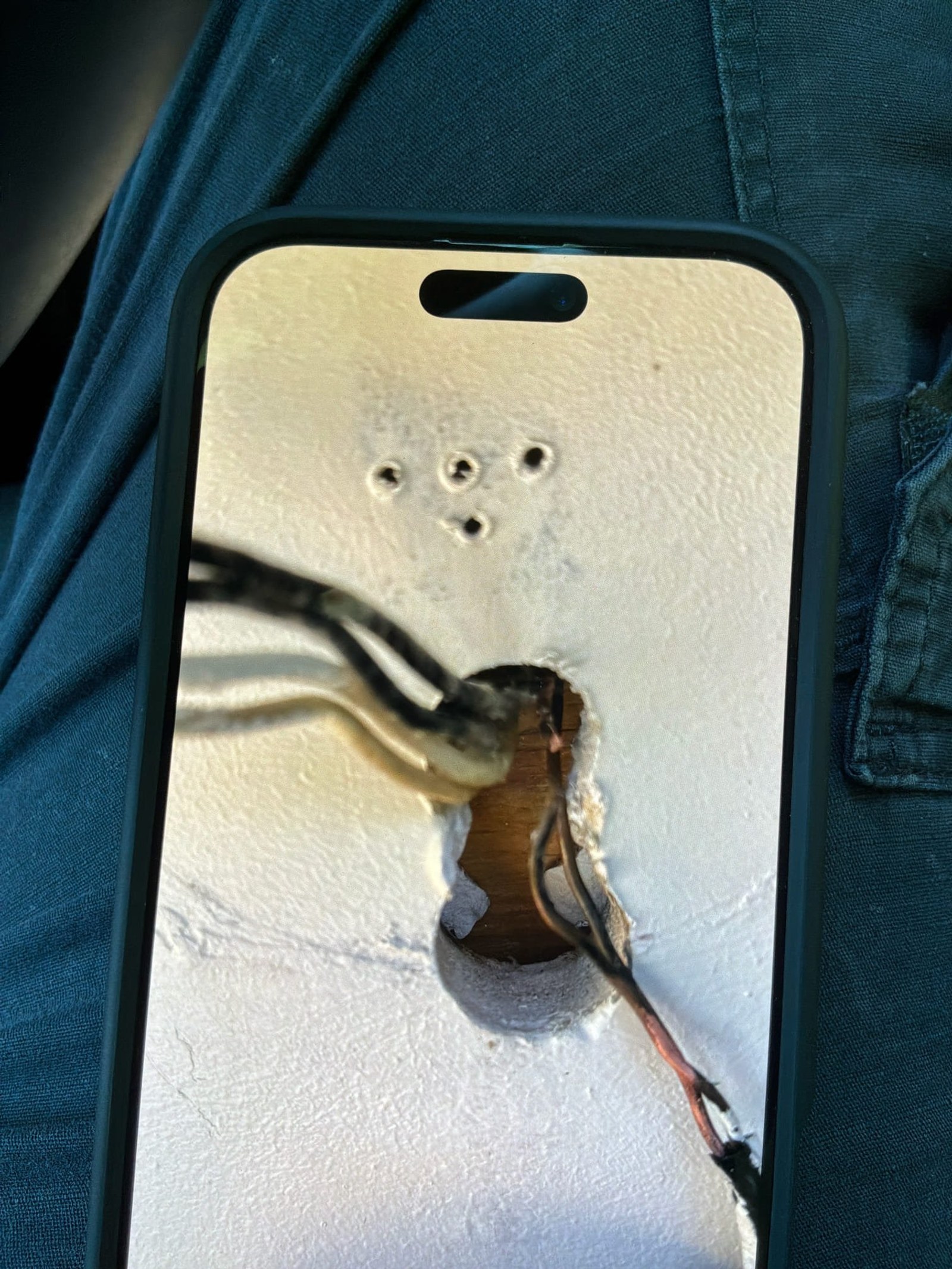
That rust is not a rare find. We photograph green, pitted wires on outdoor fixtures around Winter Park and Maitland month after month.
Lightning and Surge Protection
Central Florida records more lightning than any other part of the country. The National Weather Service publishes clear guidance on lightning safety for our storm season. A strike does not need to hit your roof to destroy a camera or a doorbell.
Protection works in layers. A whole-home surge device at the panel takes the first hit. An inline protector on the Ethernet run then shields the camera, the switch, and the recorder behind it. The Electrical Safety Foundation International offers more guidance on protecting a connected home.
Hardwiring Does Not Fix Wi-Fi
Power and signal are separate problems. A wired doorbell still needs a solid wireless link unless it runs on Ethernet. Stucco with metal lath and concrete block both weaken Wi-Fi badly.
Check signal at the exact mounting spot before anyone drills. If it is weak, a mesh node in the garage or a wired access point usually solves it. We can pull cable for that access point while the attic is already open.
Code, Permits, and Florida Rules Worth Knowing
Low-voltage cable has few rules, but the power side is another story. Adding a circuit or swapping a transformer follows the Florida Building Code and the National Electrical Code. Grounding, cable type, and box choice all get reviewed on permitted work.
Florida also adds an audio wrinkle. State law generally requires consent from all parties to record a private talk. Because of that, many owners simply turn off the mic on units facing a shared walkway.
Check your community rules as well. Some Central Florida HOAs limit where cameras may be mounted, or ask for hardware that matches the front of the house.
Questions to Ask Before Installation
- What is my existing transformer rated, and can it carry this device?
- Will the cable stay concealed, and where exactly does it enter the wall?
- Is surge protection included at the panel and on the data line?
- What happens to recording if the internet or the power drops?
- Does any part of this job require a permit?
It is also worth checking the rest of your system while we are on site. An electrical safety inspection flags aging connections and grounding gaps. Our Orlando home electrical safety checklist is a good place to start.
Plan for the Next Device Now
Most homeowners add more devices over time. If a smart lock, a floodlight cam, or a second doorbell is coming, we can leave pathways and room for it. That saves opening the same wall twice.
Our guide to future-proofing your Orlando home for smart tech covers the panel and wiring side of that plan. Think of it as reserving space before you need it.
Get It Wired Right the First Time
Cameras and doorbells fail early when the power behind them is an afterthought. Plan the transformer, the pathway, the weatherproofing, and the surge protection together. Done in that order, the wiring outlasts the gear it feeds. We recently combined outlet, wiring, and safety-system work for one family, and you can see how we handled this for an Orlando-area home.
Ready to hardwire your cameras and doorbell? Call Thomas Edison Electric at (407) 490-0004 to speak with a licensed Orlando electrician. We work under Florida license EC13015487 and give you a written quote before we begin. We serve Orlando, Winter Park, Apopka, Kissimmee, and nearby communities.