
A ceiling fan earns its keep here more than almost anywhere. Moving air makes a room feel several degrees cooler, so you can nudge the thermostat up and never notice. Done poorly, a fan wobbles, hums and slowly works loose from the ceiling. Here is how to plan a ceiling fan installation Orlando homeowners will be happy with, from blade size to the box overhead.
Fans Cool People, Not Rooms
That rule changes how you should use them. A fan creates a wind-chill effect on skin. It does not cool the air itself, so the savings only show up when you raise the thermostat to match.
So turn the fan off when the room empties. Leaving it running adds a little motor heat and no benefit.
ENERGY STAR points out that the savings appear when you pair a fan with a higher thermostat setting. In a climate that runs air conditioning ten months a year, a few degrees adds up quickly.
Damp-Rated, Wet-Rated and the Lanai Question
Indoor fans belong indoors. A covered porch or screened lanai needs at least a damp-listed fan, while an open patio or pergola needs a wet-listed one.
Here is the Central Florida catch. Wind-driven rain reaches most screen enclosures, so we often suggest wet-listed hardware even under screen. Sealed motors, ABS blades and coated or stainless fasteners resist the humidity that ruins wood blades and plain steel screws.
Outdoor fan circuits also need ground-fault protection, and the switch or control has to be rated for its location. Those details get skipped constantly on weekend installs.
Wind is the last outdoor factor. Storm gusts can spin an idle fan backward and stress the mount, so an exposed fan needs solid anchoring and a downrod suited to the height.
What Goes Into a Ceiling Fan Installation Orlando Homes Need
Start by sizing the fan to the room. Spaces under 150 square feet do well with a 42- to 44-inch blade span. Great rooms over 400 square feet usually want 52 inches or more, and very large spaces perform better with two fans than one oversized unit.
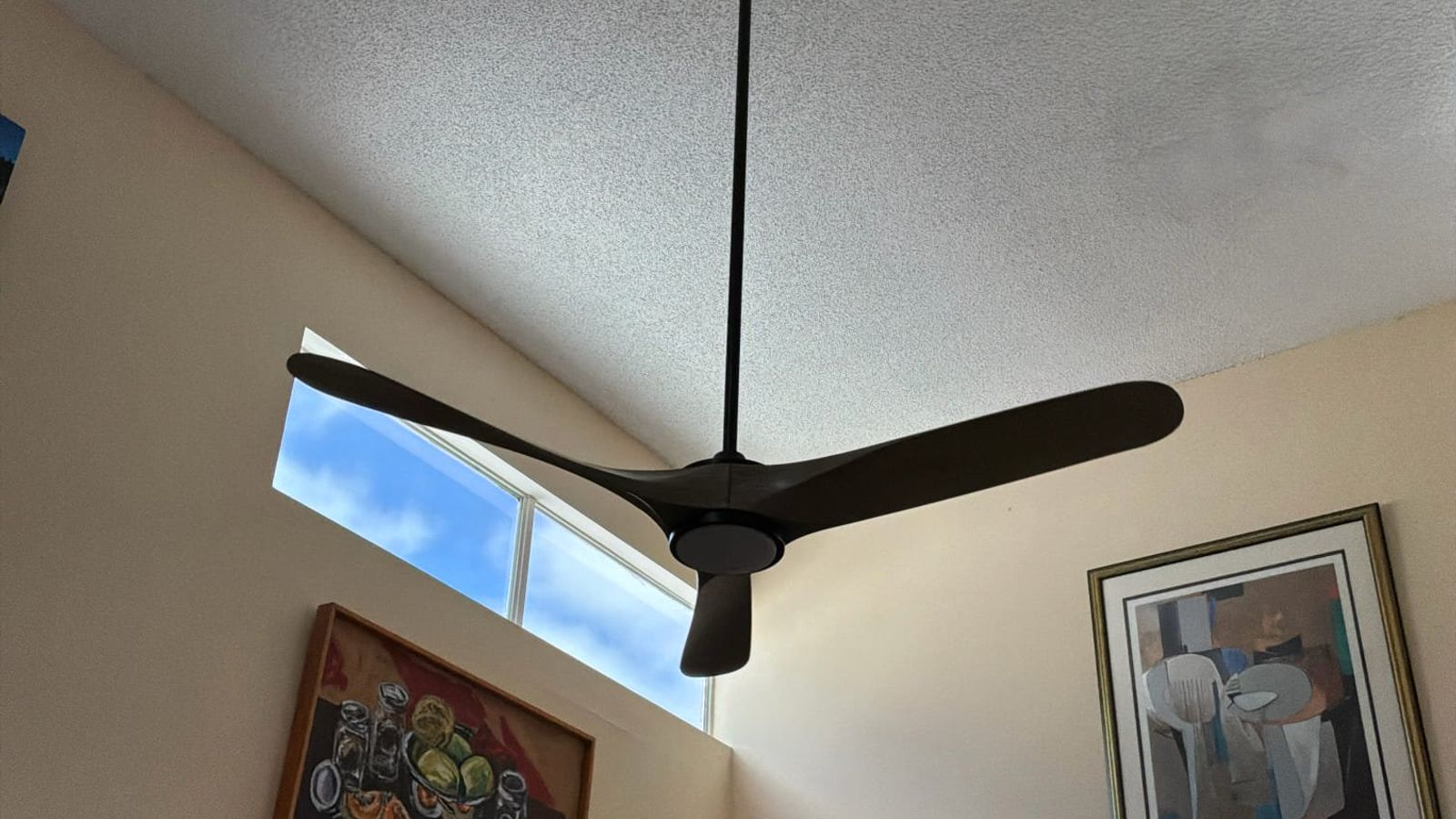
Height drives the rest of the plan. Keep blades at least seven feet above the floor, and about ten inches below the ceiling for airflow. Two-story great rooms, common in newer Central Florida construction, need a long downrod to bring the fan into the living zone.
Before ordering anything, we confirm these details:
- Blade span matched to room size and furniture layout
- Downrod length for the real ceiling height and any slope
- Damp or wet listing for anything outside conditioned space
- A sloped-ceiling adapter where the pitch requires one
- Airflow rating in CFM, not just the look of the blades
- Whether the switch box has a neutral for a smart control
The Box Is the Part People Get Wrong
A standard lighting box is not rated to hold a moving fan. It supports a static fixture and nothing more. Fans require a listed fan-rated box anchored to framing or carried by a braced hanger.
Older homes make this harder. Plaster, textured ceilings and truss spacing all block easy access, so a retrofit brace has to go in from below without wrecking the finish.
That is why every ceiling fan installation Orlando electricians perform begins at the box. A fan that shakes right after mounting is almost always a support problem, not a blade problem.
Wiring, Switches and Smart Controls
Many rooms were wired with a single switch leg for a light. Independent fan and light control then requires another conductor, a wireless wall control, or a smart module in the canopy.
DC-motor fans deserve a look while you shop. They draw noticeably less power, run quieter, and usually ship with a multi-speed remote.
One caution on controls. A standard light dimmer will make a fan motor hum and can damage it, so fan speed needs a control made for motor loads. Older homes also lack a neutral in many switch boxes, which rules out some smart controls until a wire gets added.
If you are already chasing comfort and efficiency, our notes on smart thermostats and on energy-efficient upgrades for older homes pair naturally with new fans. The Department of Energy covers the cooling math in more depth.
Fans Over Pools, Spas and Outdoor Kitchens
Water changes the rules again. A fan above a pool or spa has to be listed for that location. It also has to sit high above the surface, so plan on at least twelve feet above the maximum water level.
Outdoor kitchens add grease and salt air to the humidity. Choose a sealed motor and clean the blades more often than you would indoors.
See how one home handled an indoor and outdoor fan upgrade in Windermere after a cracked socket turned up during service.
Keeping It Quiet, Balanced and Long-Lived
Humidity warps inexpensive blades unevenly, and that is the leading cause of wobble in older fans. Uneven dust buildup does the same thing on a smaller scale.
A short maintenance routine keeps a fan smooth for years:
- Wipe blades every few months, top and bottom
- Check canopy, downrod and blade screws once a year
- Use the balancing kit that shipped with the fan
- Run the fan counterclockwise for a cooling downdraft
- Replace any incompatible dimmer that makes the motor hum
When to Replace Instead of Repair
Flickering lights, a burning smell, a fan that only starts after a push, or wobble that survives balancing all point toward replacement. Motors that have spun through a decade of Florida heat have earned retirement.
Our licensed team handles ceiling fan installation from box upgrades and sloped ceilings to lanai-rated hardware and smart controls. Ready to book a ceiling fan installation Orlando homeowners can count on? Call Thomas Edison Electric at (407) 490-0004. We hold Florida license EC13015487 and serve Orlando, Winter Park, Lake Mary, Winter Garden and nearby communities.