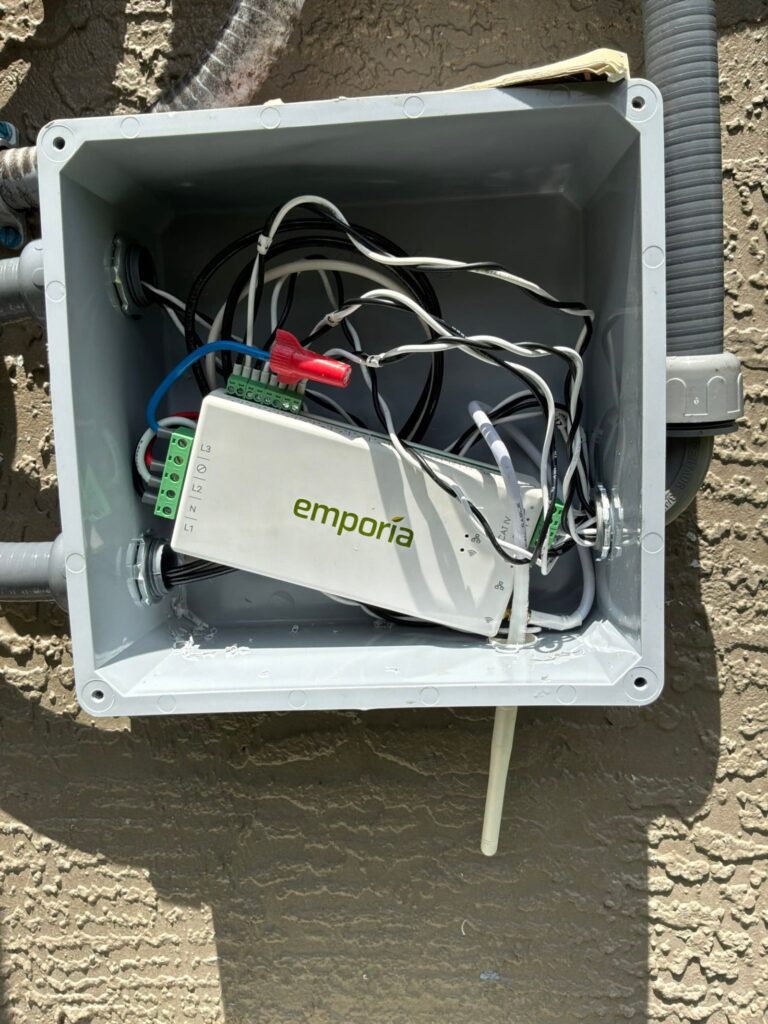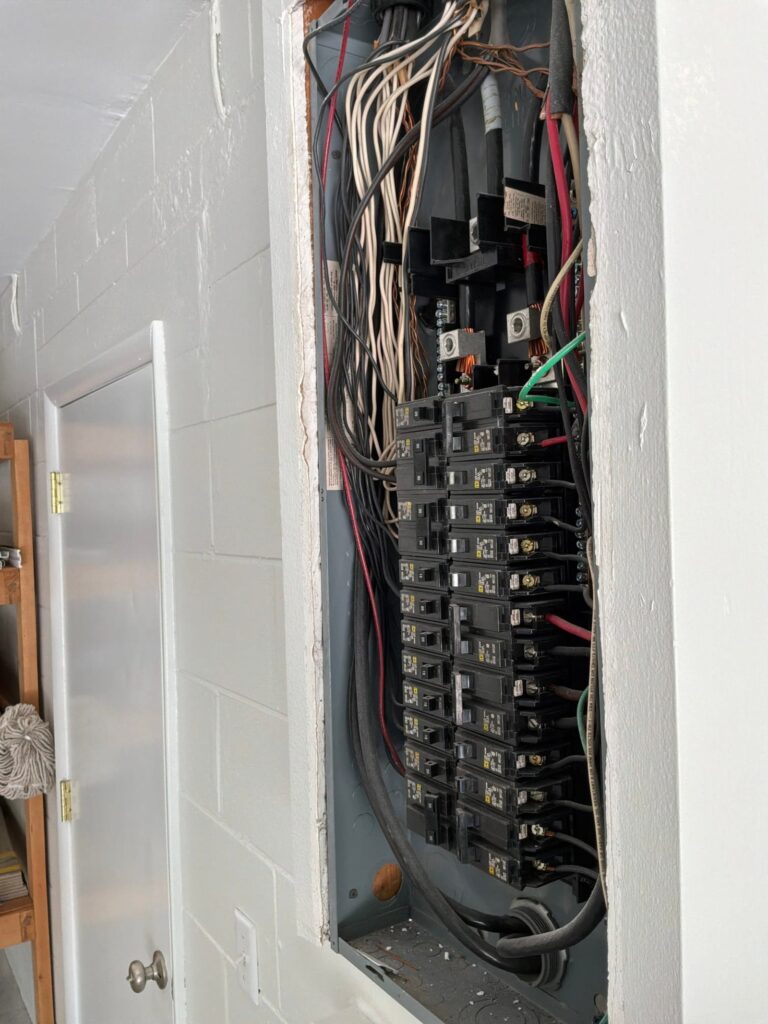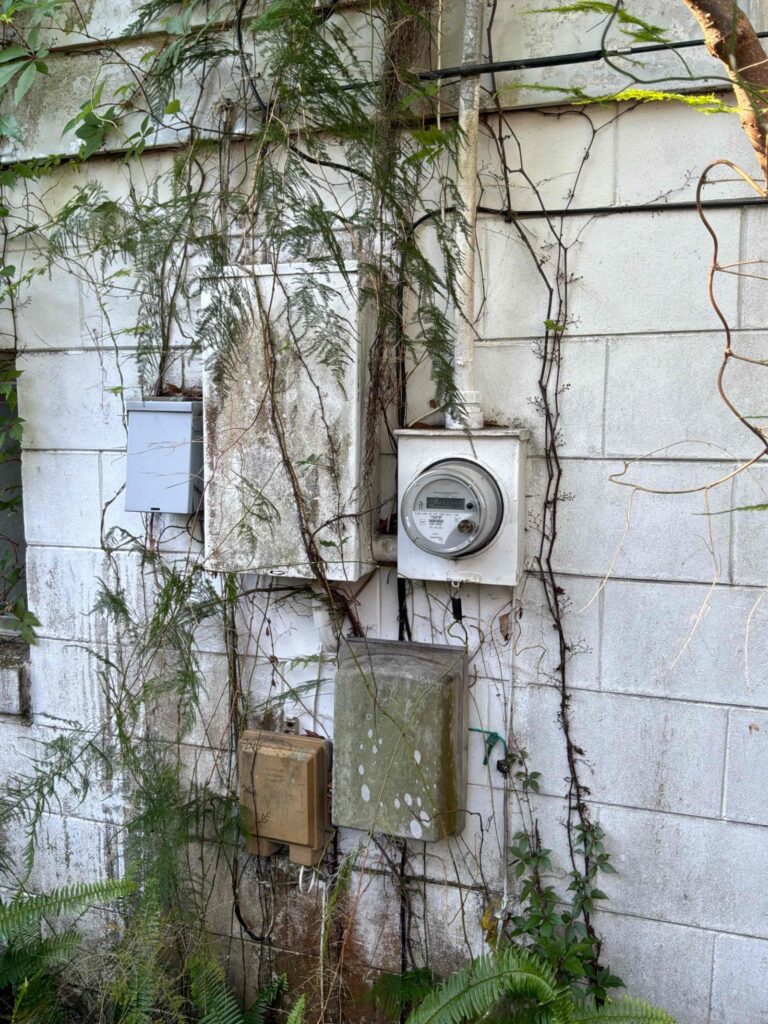
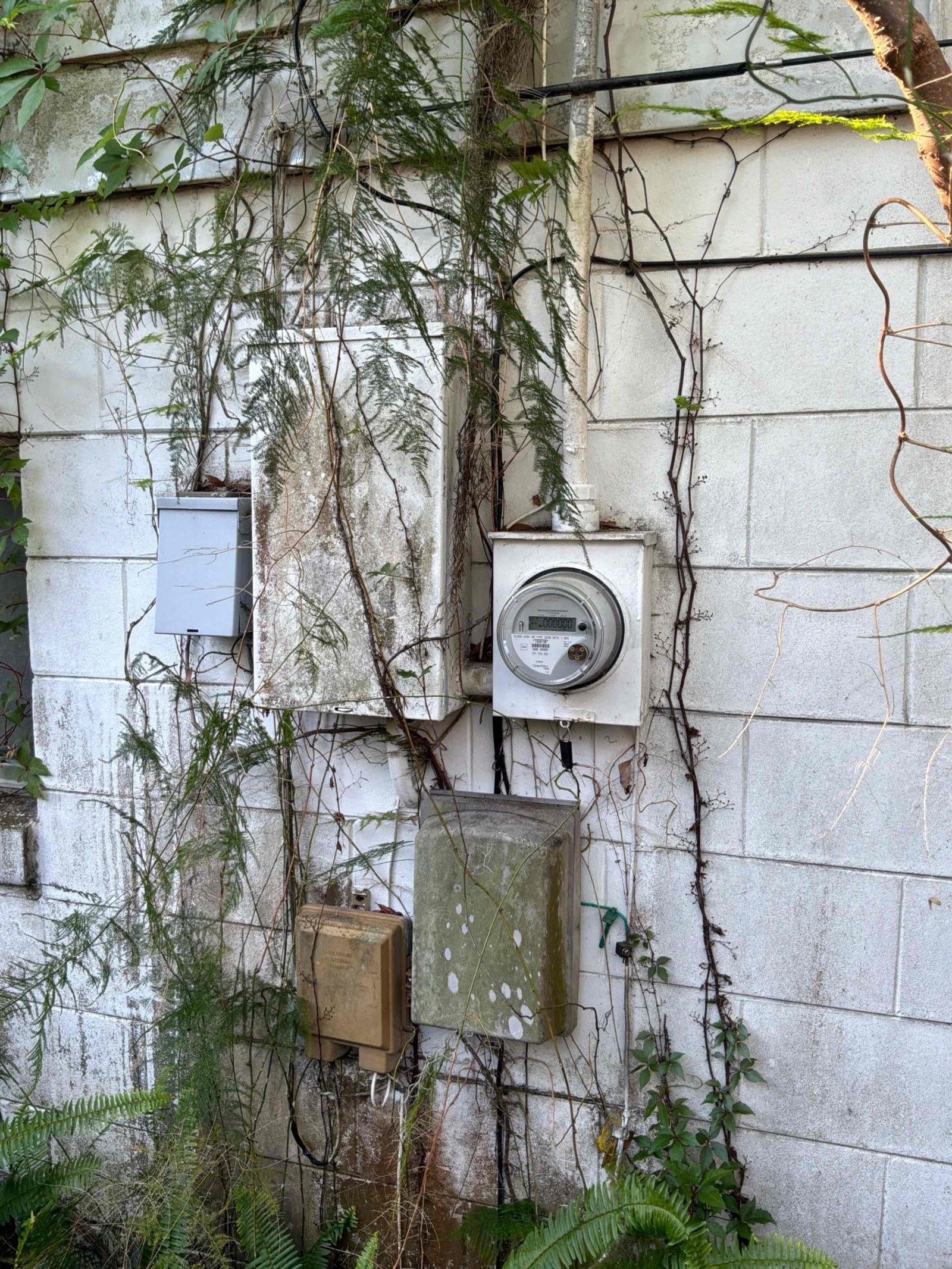
Here is how a surge protection job came together for one Belle Isle family, from the first test to the final walkthrough. A homeowner in Belle Isle, FL scheduled a full electrical service upgrade after a safety inspection revealed several areas that had fallen behind current code, including backstabbed outlet connections, a single grounding rod, an open panel knockout, and no whole-home surge protection. Our field team completed a comprehensive modernization: a new Siemens meter center, two Square D HomeLine sub-panels, ten dual-purpose AFCI/GFCI breakers, and a PSP Vortex 120 kA whole-house surge protector. The result is a home the family can rely on through every Florida storm season, quietly and without interruption.
The Problem
The homeowner wanted the home’s electrical system brought up to current standards. During the pre-job safety inspection, our crew flagged several conditions worth addressing before the upgrade work began.
“I just wanted to know everything was right, that the house was set up the way it should be and that we weren’t going to have problems down the road.”
That’s exactly the kind of outcome we aimed to deliver.
Investigation
Our technician on-site conducted a full visual safety inspection of the existing GE 200-amp service before any work began. Here’s what the inspection surfaced:
Grounding System
The inspection identified only a single ground rod at the service entrance. NEC 250.52 requires a grounding electrode system (typically two ground rods a minimum of six feet apart, or a supplemental electrode) to provide a reliable fault-current return path. A single rod is consistent with older installs, but today’s code calls for verification or supplementation.
Backstabbed Outlet Connections
The home’s outlets were wired using the backstab (push-in) method, a common shortcut in homes wired before roughly 2005. Over time, the spring tension in push-in terminals eases and contact resistance climbs. That’s the kind of intermittent behavior that can show up as flickering lights or outlets that feel slightly warm. Replacing these with screw-terminated connections is a durable, straightforward fix.
Open Panel Knockout
The existing panel had an open blank, an uncovered knockout opening. This predates current NEC requirements and is easy to address with the right bushing or filler plate.
No Surge Protection
The home had no whole-house surge protective device. Florida’s lightning frequency makes this one of the most practical upgrades available to Orlando-area homeowners. Without panel-level surge protection, every connected appliance (the refrigerator, HVAC, televisions, computers) absorbs the full impact of a voltage transient.
What We Fixed
With permits pulled and approved, our crew completed the following scope of work:
Meter Center Replacement
We removed the existing meter center and installed a new Siemens 200-amp, 8-space surface-mount meter center (MC0816B1200CT). This serves as the service entry point and feeds the new distribution panels downstream.
Main Distribution Panel
We installed a Square D HomeLine 225-amp main lug panel, 40-space/80-circuit (HOM3060L225PC) as the primary distribution panel. Alongside it, we added a Square D HomeLine 100-amp exterior main breaker panel, 12-space/24-circuit (HOM1224M100PRB) to handle dedicated outdoor or sub-fed circuits.
Breaker inventory across both panels includes: – Two Square D HOM250 two-pole 50-amp breakers – Two Square D HOM230 two-pole 30-amp breakers – Two Square D HOM220 two-pole 20-amp breakers – Six Square D HOM120 single-pole 20-amp breakers – Ten Square D HOM115 single-pole 15-amp breakers – Ten Square D HOM115PDF plug-on neutral dual-purpose AFCI/GFCI single-pole breakers, covering the branch circuits that require both arc-fault and ground-fault protection under current code
Feeders and Conduit
Our crew ran 60 feet of 4/0-4/0-4/0-2/0 aluminum SER cable in a concealed area to connect the meter center to the main distribution panel. We also installed 75 feet of 3/4-inch PVC conduit, secured with 17 two-hole straps, and pulled 75 feet each of #10 solid THHN in black, red, white, and green to serve the 30-amp dedicated circuit run.
Whole-House Surge Protection
We installed a PSP Vortex 120 kA whole-house surge protector at the panel. Rated at 120 kA, it provides panel-level protection against lightning-induced transient voltages and utility switching surges. Your refrigerator, HVAC, computers, and televisions now ride out every storm without skipping a beat.
Backstab Remediation
All backstabbed connections identified during the inspection were replaced with properly torqued screw-terminal connections throughout the home.
Open Knockout
The open blank in the original panel was addressed and properly covered before the panel was decommissioned.
Why This Surge Protection Matters for Belle Isle Homeowners
For a family in Belle Isle, FL, this kind of upgrade is about daily confidence, not drama. The morning routine runs on reliable power. The kids’ devices charge overnight without a second thought. The AC keeps running when afternoon storms roll through. That’s the everyday experience this work is designed to support.
Florida consistently ranks among the top states for lightning strikes per square mile. Panel-level surge protection, specifically a Type 2 SPD installed per NEC 285.25, is one of the most practical investments an Orlando-area homeowner can make. With the PSP Vortex in place, the home keeps running the way the family expects it to: quietly, through every storm and season.
The dual-purpose AFCI/GFCI breakers add a meaningful layer of protection to living areas and wet-location circuits without any change to how the outlets look or feel. Additionally, the new Square D HomeLine panels provide ample space for future circuits (an EV charger, a hot tub, a generator transfer switch) without ever wondering whether there’s room in the panel.
Because this work was permitted and inspected through Orange County, the homeowner has a documented record of code compliance. That matters at resale, during insurance reviews, and simply for peace of mind. Our team is licensed under Florida EC13015487. You can verify that credential anytime at the Florida DBPR.
For more general guidance on home electrical safety, the Electrical Safety Foundation International (ESFI) publishes homeowner-focused resources updated to current NEC standards.
Code Compliance Cited in This Job
Every fix above maps to a specific section of the 2020 NEC, the edition Florida enforces under the 8th Edition Florida Building Code. Florida adopts the 2023 edition of the NEC when the 9th Edition takes effect on December 31, 2026. Each card links to NFPA’s public NEC index.
Surge Protective Device at Service
NEC 230.67 requires a listed surge protective device (SPD) at the service of all new dwelling units. This home had no surge protection at the time of inspection, a condition consistent with older installations that predate the requirement. We installed a PSP Vortex 120 kA whole-house SPD at the new panel to bring the service into full compliance. NFPA reference ›
Type 2 SPD Installation Requirements
NEC 285.25 governs the installation of Type 2 SPDs on the load side of the service disconnect. The PSP Vortex unit was connected at the Square D HomeLine distribution panel per this section, ensuring both proper mounting and correct conductor sizing to the SPD terminals. NFPA reference ›
AFCI Protection for Dwelling Units
NEC 210.12 requires arc-fault circuit interrupter protection on branch circuits supplying outlets in dwelling unit living areas, bedrooms, kitchens, and similar spaces. Ten Square D HOM115PDF dual-purpose AFCI/GFCI plug-on neutral breakers were installed across the new panels to satisfy this requirement throughout the home. NFPA reference ›
GFCI Protection for Personnel
NEC 210.8 requires GFCI protection at receptacles in kitchens, bathrooms, garages, outdoor locations, and other specified areas. The dual-purpose HOM115PDF breakers installed on applicable branch circuits provide both AFCI and GFCI protection at the panel level, covering the home’s GFCI-required locations under a single device. NFPA reference ›
Grounding Electrodes
NEC 250.52 defines acceptable grounding electrodes, including driven ground rods. The inspection found only a single ground rod at the service, consistent with older installs but below the supplemental electrode requirements of the current grounding electrode system rules. The new service installation addresses the grounding electrode system as part of the permitted scope. NFPA reference ›
Unused Panel Openings
NEC 408.7 requires that unused openings in panelboards be closed with listed filler plates or bushings. The inspection identified an open knockout in the existing panel. This was addressed prior to decommissioning the original equipment. NFPA reference ›
Common Questions
Questions homeowners ask after seeing this kind of work.
What is a backstabbed outlet connection and why does it matter?
Backstabbed connections use a push-in spring terminal on the back of the outlet rather than a screw on the side. This was a common wiring method in homes built before roughly 2005. Over time the spring tension eases, contact resistance increases, and you may notice intermittent flickering or outlets that feel slightly warm. Replacing them with properly torqued screw-terminal connections is a straightforward fix that restores reliable performance to every outlet in the home. If your home is from that era and you’ve noticed any flickering, our team can schedule a full outlet inspection to check the connections throughout.
Why do I need more than one ground rod at my service entrance?
A single ground rod may not provide a low-enough resistance path to reliably handle fault current, especially in Florida’s sandy soil. Current NEC standards under Section 250.52 require either two ground rods spaced at least six feet apart or a supplemental grounding electrode to form a proper grounding electrode system. Homes with only one rod are consistent with older installation practices, but a licensed electrician can verify and supplement the system during a service upgrade. Unsure whether your home has this condition? Our team can book a visual safety inspection so you know exactly where things stand.
How does a whole-house surge protector differ from a plug-in power strip?
A plug-in surge strip only protects the devices plugged directly into it, and most are rated for just a few thousand joules. A whole-house Type 2 surge protector, like the PSP Vortex 120 kA unit we install at the panel, intercepts transient voltage at the service entrance before it can reach any circuit in the home. Every appliance, HVAC system, and piece of electronics is covered. Florida’s high lightning frequency makes panel-level surge protection one of the most practical upgrades available to homeowners in the Orlando area. Schedule online if you’d like us to add one to your existing panel.
How often should I have my home’s electrical system inspected?
A yearly inspection is a solid baseline for most homeowners. It catches small changes before they become larger ones and keeps your documentation current. Homes built before 1990 and homes that have come through a recent storm season can benefit from inspections more frequently, since older wiring systems and weather events can each accelerate wear in ways that aren’t always visible from the outside. Our licensed team can walk through the whole home in about an hour. Schedule online to get on the calendar for your annual check.
What is the difference between an AFCI breaker and a GFCI breaker?
A GFCI breaker monitors for ground faults (current leaking outside the intended circuit path, such as through water or a person) and trips in about 1/40th of a second. An AFCI breaker monitors for arc faults, the kind of unintended electrical arcing that can occur inside damaged wiring or at loose connections. NEC 210.12 requires AFCI protection in living areas, and NEC 210.8 requires GFCI protection near water sources. Dual-purpose AFCI/GFCI breakers like the Square D HOM115PDF satisfy both requirements with a single panel-mounted device, keeping the panel clean and the home’s circuits fully protected. Book a panel review if you’d like to know which breakers in your current panel meet today’s standards.
Want to see more real jobs like this one? Browse our completed case studies or explore our services.